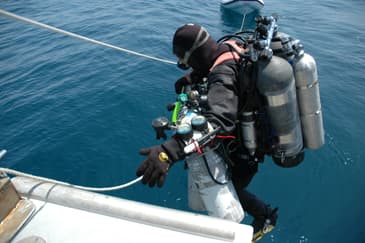
Wreck diving is a perfect mix of maritime history and ocean exploration and that is why we at ATB are fascinated with the subject. For the past five decades, Eric Takajian has been diving on deepest and most infamous wrecks in the world and at the same time discovering over seventy of history's most notorious lost ships. From German U-Boats to ocean liners, if it sank on the East Coast of the United States, chances are Eric has dove to find them. Join us as we talk with Eric about the exhilaration and dangers of a sport that has evolved from a niche hobby into a highly sophisticated and technologically advanced endeavor.
[00:00:00] Broadcasting for the East Passage Football Wright Studios. I'm Carter Richard and I'm here with Tyler Fields of Tyler Fields photography Tyler.
[00:00:28] All is right with the world. Baseball is back. I'm so excited. I friggin love the beginning of the baseball season because of very many reasons, but one, it's baseball to there's going to be something on TV for the next like 27 months and it also signifies spring.
[00:00:51] I mean, I don't know if I get so excited about baseball because I just love baseball or because I am so excited for spring to occur and they just happen to coincide.
[00:01:05] I'm enjoying this so far this year. I'm really excited for the Cape Cod Baseball League to start back up. Those games are always a lot of fun to go see, but it's not just baseball. You and I have been keeping up with the hometown favors the Rhode Island Football Club too.
[00:01:21] Yeah, that's also very true. Season ticket members, our family is and Tyler's been good, good enough to come join us for a couple of matches. It's been awesome if people who are not familiar and all the people that are listening outside of this country or maybe not soccer fans or football
[00:01:37] fans, I would say all the people listening inside the country that don't know what soccer is. Yeah, our international fans probably already know all this probably already know, but it's the it's a tier below the MLS, the major league
[00:01:52] soccer here in the United States. So it's kind of like AAA soccer, but it's it's a ton of fun. We've been to a couple games so far. Sorry, a couple matches so far and really has been a ton of fun to go to.
[00:02:05] It's a bit of a Rhode Island cluster, as one would expect for their new stadium in Pawtucket. I think they had allocated like $28 million for the construction of the new stadium downtown Pawtucket and it's it's right now.
[00:02:20] I think their average average like 138 million. So it's a little little over budget. But they're playing at Bryant College for this season and their university given the props that they're due. Sorry.
[00:02:33] It's a university. I was really, really impressed with the inaugural game that we went to. They do a really nice job. It's a it's a really cool atmosphere. They do a lot. There's food trucks. There's events throughout the day tailgating.
[00:02:50] It's it's a really cool setup. Maybe RFC will plug around the buoy as like an ancillary follower. We could be the Rhode Island FC's official maritime podcast.
[00:03:03] We just be Rhode Island. You listen to the radio, the road, the Red Sox have official everything. That's true. Official hot dogs, official beer, official weight loss partner of the Boston Red Sox.
[00:03:20] They've got like official like luggage and official facial cream. I mean, yeah. Listen, maybe the 24 could maybe the Red Sox official luxury center console where it's not that we're above selling out issues.
[00:03:39] We've never been approached offered like I'm not that I also that's fine. So everything's was sale.
[00:03:49] Yep. I've said it a million times that people get mad at other people who sell out just have never been offered the ability to sell out.
[00:03:58] I have standards. They are low.
[00:04:01] Very true. That's very true. My friend that's very true. Before we get into this episode, there's a couple of news topics we were going to talk about later on the show.
[00:04:14] We want to tell you about one is there is a pretty cool cast away story from the South Pacific. It's it takes a surprise twist. Not quite like sixth sense surprise twist, but it takes a pretty good surprise twist.
[00:04:27] And I think listeners will know the surprise is not that I want to trade places with these people.
[00:04:33] I think that's just assumed at this point. That's just assumed at this point.
[00:04:37] Next, the former topic or a former guest on the show, the USS New Jersey, the battleship New Jersey has been going just recently went into dry dock for some routine maintenance.
[00:04:51] And then friend of the podcast friend of the show, friend of all of ours. Mr. Adam Cove has signed up for the race to Alaska and I cannot wait for that.
[00:05:04] And then finally, I know everyone's been baited breath with it. The episode's a little bit delayed this month's because we've just been baited breath waiting for the news conference coming out of North Carolina.
[00:05:16] The stingray, the immaculate conception stingray Charlotte will have a little update on that.
[00:05:24] I we've covered some interesting topics on the show.
[00:05:28] That's not one of them.
[00:05:30] This is not one of them.
[00:05:33] I disagree wholeheartedly.
[00:05:36] Along with the news topics are guests for tonight is an expert in maritime history and deep ocean wreck diving.
[00:05:42] Join us as we talk about what it takes to explore the most notorious deep sea wrecks like the Italian ocean liner Andrea Doria off Nantucket and you 853 sunk near Block Island at the end of World War Two.
[00:05:56] It's not an episode to be missed and will be right back after this short break.
[00:06:11] Frequent listeners to around the buoy are familiar with our fascination of maritime history and ocean exploration and few subjects combine those better than wreck diving.
[00:06:40] On today's episode we are going to be joined by Eric Dacagin a professional mariner author and technical diving expert with more than 50 years of researching and diving under his belt.
[00:06:50] Along with diving many of the deepest and most dangerous wrecks around the globe.
[00:06:55] Eric has identified more than 70 previously undiscovered shipwrecks along the U.S. East Coast from German you boats to ocean liners.
[00:07:02] Eric has been at the forefront of wreck diving and we are excited to have him on the show.
[00:07:06] Eric welcome to around the buoy and thanks for coming on.
[00:07:10] Yeah, look forward to talking to you guys before we get too deep into your adventures wreck diving every guest story starts somewhere for us Carter trained as a diver in the Navy and I learned to dive in college.
[00:07:21] What opened the door for you into diving what was your first dive.
[00:07:25] Well, I am originally from New York I was born and raised I was born in Manhattan and I was raised just outside the city and I grew up small town called Piermont which is right next to the tap and Z bridge.
[00:07:40] And I'd been in the water since I was a little very small kid and we used to vacation on a cake would go up and stay in a cottage and Brewster and every summer, you know everybody from New York or Jersey they either go down to Jersey shore they go to Cape Cod, you know.
[00:08:01] And so I used to go snorkeling when I was you know basically a toddler on the, the Brewster flats and I always wanted to dive in.
[00:08:14] In the town that I lived in in New York, you could join the volunteer fire department at age 15 so I did that.
[00:08:23] And at the same time I also got certified as a diver. There was a guy that was Joe McCurrio was his name he was in the fire department and he was a now we instructor, and you could get a now a junior certification at 15 so I became certified at 15 and my brother did too.
[00:08:43] And we started diving, you know, pretty much immediately in the Hudson River. And then everybody that dove in that area would usually do a lot of our diving and either Long Island sound or off the south coast along Island or off the Jersey shore and and it was wreck diving was pretty much what everybody did.
[00:09:05] And, and the first wreck dive that I did was a was a wreck called a black warrior was in 35 feet of water just outside of sheep said Bay Brooklyn.
[00:09:15] And so growing up as a kid and all through high school and stuff. I dove with with Bill Redden on the Terry and Salarina on the original sea hunter, and then Paul Hepler on adventure was Paul ran out of Jersey so growing up I did a lot of wreck diving off off along Island and off of Jersey.
[00:09:42] And that was kind of my introduction to it.
[00:09:47] Cases of decompression sickness more commonly known as the bends date back into the the mid 1800s when they started constructing the St. Louis bridges or the St. Louis and the Brooklyn bridges so many and many people are aware of the dangers of the recreational scuba diving the kind you were doing, but
[00:10:06] the other wrecks that you kind of are looking at now are in such great depths that they need specialized equipment and just kind of an evolution of equipment.
[00:10:15] Talk to us about the problems, first of all, like in just regular diving with that was something like the bends, but also why is it necessary as you start going deeper and deeper that you had to figure out a different way to approach the the those dives.
[00:10:31] Well, if that evolved over time, you know, and the Ben Ben's happen is a friend of mine, Glenn Butler like to say, you know, Ben's happen.
[00:10:42] And they can happen for a multitude of reasons. And basically what happens is is is is dillulent gas whether if you're somebody's diving on air that would be nitrogen if they're diving on a helium based mixture would be helium.
[00:10:58] Basically comes out of solution and and gets enters the bloodstream and then gets lodged in the joints, which can be extremely painful. It can also be fatal.
[00:11:11] So it can happen from people diving. I was bent pretty good back in 1995 dive in the U boat had to get meta backed off by helicopter.
[00:11:23] He sent me to the chamber in New London, put me in a tank there and squeeze me down did what they call a treatment table six and decompression theory and and the science of diving is something that's, it's constantly evolving and has evolved over time.
[00:11:40] And it's still evolving to this day, it's still still evolving even more. And, and we've come a long way with that too. And in the early days of what they call today called technical diving at the time we just in the beginning we just called it essentially deep wreck diving or wreck diving.
[00:12:00] And I guess it was in the about the mid 90s the phrase got coined of quote unquote technical diving. And there was sort of a revolution where it became much more mainstream.
[00:12:13] And a couple of things needed to happen because some of us were initially everybody was doing deep dives we're diving deep on air. And, and we, we, you know summarize just doing the basic math that would guess partial pressures that it would be better to decompress on
[00:12:34] oxygen so some of us started hanging over the side we have like a big tea bottle, 300 cubic foot bottle with a two stage regulator, and then along hose going down to about 20 feet or so which is a deep as it she can breathe pure oxygen and have like a wide valve and some whips coming off with regulator
[00:12:53] regulator second stage is hanging off it. And we do in water deco on 02 for our 20 and 10 foot stops. And the Navy had some tables that got kind of close for that. And initially, early early on, we just use the Navy decompression tables and because there was nothing else out there, you know,
[00:13:14] into 70s in the 80s that was pretty much all there was. And then the Canadian forces came up with their tables, or essentially cold water tables which are much more conservative.
[00:13:28] And we thought well those might be a good way to go to but then that introduced another set of problems because prolonged exposure to cold can predispose you to decompression sickness as well.
[00:13:39] So there was issues with that. And then we were fortunate in our community to have two really good friends.
[00:13:47] Dr. Bill Hamilton, who was actually a friend of mine since childhood and Glenn Butler and Bill Hamilton was a diving physiologist who developed and basically cut decompression tables for the offshore oil industry.
[00:14:05] Back in the days before you could do it on now you can do it on your iPhone, which it just blows my mind. In the early days, it was long hand math and algorithms. So you'd have literally, you know, a couple of legal paths and working it out mathematically
[00:14:24] based on partial pressures of gas and what you were going to breathe. And Glenn Butler was involved in commercial diving as well and basically designing and composing gas and breathing gases for the commercial diving saturation diving industry.
[00:14:43] And they were also recreational divers and Dr. Bill and Glenn said, if you guys are going to do this, we can come up with some gases that would probably be ideal because in the early days we're just sort of winging it.
[00:15:00] Put a little helium in here, put a little oxygen, top it off with nitrogen, see what we got, you know, mathematically figure out a table and go. Well, you know, that's extremely cumbersome.
[00:15:11] And not to mention it's not really efficient when, you know, for blending gas because we're all we're blending by partial pressure methods, which is still done today.
[00:15:23] But so what what Dr. Bill and Glenn did is they came up with some standardized gases, and the two standardized gases were 1830 and 1750 1830 is 18% oxygen 30% helium and the balance is nitrogen.
[00:15:41] 1750 is 17% oxygen 50% helium and the balance nitrogen. And the 1750 gas, my friend Billy Deans down in Key West was doing the same sort of thing that we were doing up here.
[00:15:57] And, and he got a set of tables set up called the Key West Consortium Tables. And Dr. Bill wrote those tables and it was just basically for two depths for 230 feet and 250 feet.
[00:16:11] So what we would do is if we were diving deeper than 230 we would use the 250 table.
[00:16:18] Anything down to that if it was anywhere between like 180 and 230 we'd use a 230 table so it was a step, but it wasn't the best solution.
[00:16:28] And is this what they call trimix? So yeah, and then this is trimix. Yep.
[00:16:34] And then Dr. Bill came up with the 1830 table which was a really handy table and he made it in basically 20 foot increments from 180 feet to 280 feet.
[00:16:46] And so you could as long as you're, you know, if you're going to do 200 foot dive then you'd use a 200 foot table if you can do a 210 foot dive you'd use a 220 foot table.
[00:16:58] And that worked really well. And then you'd have, we had a standard gas that you could use for that range of dives anywhere from 180 to 280 anything less than 180 or 200 most of the time we still dove air and
[00:17:16] and then we would deco usually on air and then O2 but when we were diving with trimix we would deco on nitrox and then O2.
[00:17:32] And the idea being is to increase that O2 gradient in your tissues so you're optimizing your decompression gas.
[00:17:44] At what depth are you looking at getting away from just single air and moving into like a trimix?
[00:17:54] Now it's shallower and shallower. Years ago back in the 90s and early 2000s we would dive air to about 200 feet and then anything after that because we were used to it.
[00:18:07] You know, we'd been diving 200, 250 on air for years and it was, we're just used to it.
[00:18:15] But nowadays as things have become more formalized particularly with tech training is they have like what they call normal oxy trimix which will, they'll teach that where the oxygen level is at the normal level for air is 21% oxygen but then there's like 20% helium and then the balance being nitrogen.
[00:18:45] And they'll dive normal oxy trimix from like 140 to like 180 or so and then dive something like 1555 or something like that deeper.
[00:18:58] But you know in the early days we would dive air to 180, 200 and anything below that we would dive, dive trimix.
[00:19:08] And where does the rebreather come into all this?
[00:19:12] Rebreathers are very efficient and it's, they've evolved, you know that's a newer technology in the grand scheme of things in the big picture but we're into probably generation five and rebreathers now.
[00:19:26] And what the rebreather does it's actually, it's got a lot of advantages because with the rebreather is a number of different manufacturers out there but they all pretty much work on the same principle.
[00:19:39] You have a scrubber that and you have a breathing loop and then you have oxygen in one cylinder and a dillian gas in another cylinder and that dillian gas can be air or it can be trimix or heliox.
[00:19:58] So, you know on our deeper dives we're diving usually trimix is a dillian gas and then pure oxygen.
[00:20:06] And the advantage to a rebreather is just that you're rebreathing the gas that you use like you inhale and you're inhaling your trimix from the dill cylinder.
[00:20:24] And it goes through your breathing loop.
[00:20:27] It goes actually into what we call an inhale counterlung through the breathing loop and then you exhale into an exhale counterlung.
[00:20:36] And the rebreather has oxygen sensors in it that sense the level of partial pressure of oxygen within that breathing loop.
[00:20:44] And you manually set it to whatever you want for partial pressure like I dive a rebreather now myself.
[00:20:51] I have it set at a partial pressure of oxygen of 1.2 atmospheres absolute and the beauty of the rebreather is it will maintain that 1.2 atmospheres absolute regardless of depth.
[00:21:06] So, it doesn't matter if you're at 20 feet or 300 feet.
[00:21:11] It you're still breathing 1.2 atmospheres absolute.
[00:21:16] So, it's like breathing the ideal nitrox mixture throughout your entire dive.
[00:21:22] And of course your body metabolizes the oxygen.
[00:21:27] So, you're using that up but when you like we're sitting the three of us are sitting here right now we're inhaling or exhaling and we inhale our air at 21% roughly of oxygen and 79% nitrogen we exhale.
[00:21:44] What we're exhaling is out is not pure carbon dioxide it's some carbon dioxide some nitrogen some oxygen.
[00:21:52] So, with a rebreather when you exhale, exhale goes into the exhale counterlung and from there it goes into the scrubber which is part of the loop.
[00:22:01] And the scrubber scrubs out the carbon dioxide and then coming out of the other side of the loop is essentially your diluent gas and remaining oxygen.
[00:22:13] And then electronics in your your rebreather will automatically add in additional oxygen.
[00:22:22] There's a solenoid valve and it opens it and lets in oxygen to maintain that partial pressure of oxygen.
[00:22:28] Does that also increase your time with available gas?
[00:22:32] Yes, it does dramatically so.
[00:22:36] One of the beauties for deep diving is with a rebreather is you have the ability to manage a problem should a problem arise and that gets exponentially greater with a deeper depth like when we first found the U550 down southeast in Nantucket.
[00:22:58] It's in 330 feet of water. So all of us were diving that on open circuit, but you know on the bottom, on the bottom and 330 or 350 feet of water you can visibly see your pressure gauge move.
[00:23:12] So you only have a really limited amount of time to manage a problem if you run into one.
[00:23:18] With a rebreather, the really the length of time you have is the duration of your scrubber and which in each rebreather will vary depending on the size of the scrubber some have bigger some have smaller and some of them have different size scrubber buckets that can be put in them depending upon the application or the type of dive.
[00:23:40] The rebreather that I use I have a scrubber that will last about six hours.
[00:23:46] And the one thing too with all of this type of diving.
[00:23:50] And even in the early days we always focused on redundancy.
[00:23:56] So it's not you're never relying on one specific system there's always two of everything.
[00:24:04] And backups for backups.
[00:24:08] And so that added a great deal of safety along with it.
[00:24:15] Well, let's get into a little bit of the wreck diving aspect of things.
[00:24:20] One of the most notorious wrecks and popular culture is the Italian liner Andrea Doria.
[00:24:25] It was July 1956 when the Doria collided with the Stockholm and sank less than 50 miles south in Antucket at a depth of over 200 feet it's far beyond the abilities of most divers to reach, let alone explore its interior as kind of a primer can you just walk
[00:24:43] us through a dive like this.
[00:24:45] What is the experience like going inside a wreck at such a deep depth.
[00:24:49] The Doria is a great dive.
[00:24:52] She's she's really starting to fall apart when I first stole her, she's she's laying on our starboard side in 250 feet of water.
[00:25:01] And the first diver to dive that was a guy Peter gimbal, who dove a couple of days after it sank he hired a boat to take him out from the Antucket.
[00:25:10] And there was oil slick coming up they found the wreck on a sound machine and he went down took a look at it and took some pictures that appeared in Life magazine a couple of days later.
[00:25:21] And since then, it, there's been a small cadre of people that started to dive the wreck, and it became popular within a small I'm talking back in like the 60s, 70s, and early 80s it became popular for,
[00:25:39] maybe 20 people that would go out there every year on a couple of different boats and and dive it. And I didn't realize they were going that deep that early.
[00:25:50] Yeah, yeah, I mean, there was like, I'm going to say less than two dozen people.
[00:25:57] You know, it was the same group of heavy duties.
[00:26:00] John do this.
[00:26:04] Joe Holman.
[00:26:07] I mean, even just to find it with the technology of the 50s is really impressive.
[00:26:13] Yeah, well it was you know, a lot of guys I mean when I started your kitchen timer and a compass course.
[00:26:19] Yeah, today's got everybody's got all these whiz banks.
[00:26:23] You know, you know, I can't leave the dock with but you know, Magellan got all the way over here all the way around.
[00:26:32] Right. I mean, all of that that fancy stuff's overrated, you know.
[00:26:40] I mean we we we found a lot of wrecks with just a paper machine, you know, and so when did when did the Doria become infamous as being kind of like a diver killer or some of that would is just waiting for an accident.
[00:26:56] Yeah, that started in the 90s. Because when I first stole there in the 80s, it was that at the time there was like two boats going there.
[00:27:07] Well three, there was the one who Steve Belinda's boat, the seeker from Jersey and Bill Nagel and then
[00:27:22] Sal Arena with his boat from from Freeport and and
[00:27:28] Bill, Steve and Sal all had their had their crew
[00:27:34] and both the regular crew members on a boat and the guys that will come diving with
[00:27:39] and it was like if you wanted to go on one of those boats you had to be invited
[00:27:44] and for years there was never any problems guys went out there they went diving they did their thing. They had a good time they got artifacts and it came home.
[00:27:54] And then it's in.
[00:27:57] I'm going to say
[00:28:01] I guess it was in about the early to mid 90s.
[00:28:06] The ball started to roll a little bit
[00:28:10] with technical diving. All of a sudden it became, I'm going to say a fad that that just all of a sudden
[00:28:19] more and more people started getting into it there at there was more presentations at the dive shows it it looked kind of sexy it was a little edgy
[00:28:28] you know was outside the norm so people started getting into it and then
[00:28:33] more and more people wanted to go and then
[00:28:37] other boats started going out there. The Andy Lynn as a party boat from Plymouth Party fishing boat
[00:28:44] took made a couple of trips out there there was a guy with a big wooden sport fishing boat called a Desi Dorada
[00:28:52] that ran out there and then there were some more boats leaving from Long Island
[00:28:56] and and more and more boats and you get out there sometimes and it'd be like a traffic jam to be a half a dozen boats out there who's out of control
[00:29:06] and then also people
[00:29:09] some of the guy like Sal
[00:29:12] and then Bill Nagel
[00:29:15] started to
[00:29:17] lower their standards on who they would bring they would you know somebody would show up and write a check and
[00:29:23] be like who is this guy nobody knows him you know he'd show up and so consequently people that shouldn't have been diving a wreck ended up diving a wreck
[00:29:32] and then
[00:29:34] there was a bad fatality early on on a Wahoo
[00:29:38] or my friend Billy Deans brought a friend up from Florida that was a cave diving buddy his Joe Wormsby
[00:29:47] and Joe
[00:29:49] was a guy that he was good cave diver but unfortunately
[00:29:55] in the early days of cave diving it's changed a lot now a lot of those cave diving guys thought they were bulletproof
[00:30:01] and they'd come up and it's like oh we're going to show you wreck diving guys had to do it
[00:30:06] and Joe Wormsby they were tied in at what they call Gimbal's hole which was the first class foyer doors have been cut out
[00:30:15] and a boat was hooked in there and
[00:30:19] she's laying on her side and a foyer goes completely from one side to the other
[00:30:24] and Sally Warman who was an excellent diver was in a gift shop
[00:30:29] and she was which is like if you enter the foyer doors and you drop straight down
[00:30:36] you get to about will be a midships in the ship
[00:30:39] and that depth was at about 220 or so
[00:30:42] and there was a set of glass doors that were open and Sally was in there in a gift shop and she was in it
[00:30:49] you know picture everything on its side and it's all sort of muddy and she was dig she had a like a mesh bag
[00:30:55] and she was digging slowly in the gift shop and putting stuff in her bag
[00:31:00] and she finished doing what she was doing and she just had a pair of twin steel 72s and she had a tremendous sacrate
[00:31:08] so Sally would go down and do like a 25 minute dive with a pair of steel 72s and come up and have half her tanks left
[00:31:15] so she was coming out of the gift shop
[00:31:18] and somebody comes down and basically crashes on top of her
[00:31:23] and it was Joe Ormsby he was he lost control of his buoyancy inside the hole
[00:31:29] and they both go tumble into the bottom there's a whole pile of debris
[00:31:33] planks wire cables all sorts of shit
[00:31:37] and when Joe hit her he knocked her mask off
[00:31:41] they tumbled to the bottom she gets a regulator back in her mouth
[00:31:44] and then he just bolted and she she's like what happened
[00:31:49] so she gets her other mask on clears it gets a regulator in her mouth figures out where she's at what happened
[00:31:56] and so she you know she slowly comes up and when she came out of the hole she didn't see Joe
[00:32:02] and what he did he just bolted straight up and he missed the hole and he hit to one side
[00:32:07] and he's flailing he's panicked in there and he flailing around
[00:32:12] and there used to be a whole pile of wires in there was armored cable
[00:32:16] it's like multi conductor cable with a plastic jacket over it and then metal usually bronze
[00:32:23] rated bronze over the top of it and he was all tangled up in that unbelievable
[00:32:29] and he got tangled up and he drowned in there
[00:32:33] Hank Keese was on a boat
[00:32:35] and I think Gary Gentile Gary Gillian
[00:32:39] and Gentile and Gillian went down and looked they found him
[00:32:44] and they couldn't get him out the first dive because he was so wrapped up in a cables they had cable cutters
[00:32:51] they got him partially cut out they said it's going to take a second dive so those guys
[00:32:55] and everybody already made two dives but at that point so we got to wait till tomorrow
[00:32:58] so next day to go down and they would cable cutters and they cut and cut and cut and cut
[00:33:04] and they get him out and then get a line on him and put a lift bag on him and send him up
[00:33:10] and they get him up on a boat and he still when he when he dragged him up on a boat
[00:33:14] he still had cables wrapped around his legs that's how bad he was flailing around in there
[00:33:19] and he was that's just a horrifying example of a guy that
[00:33:24] he did everything wrong you know the best piece of diving equipment that you can possibly have
[00:33:31] is right here in your head you know you got it all the fancy whiz bang stuff doesn't matter
[00:33:38] if you make dumb decisions and sadly from that point on when Joe after Joe Almsby got killed
[00:33:44] right up through
[00:33:46] the later 90s there was a series of deaths on a Doria I think one more on the on the
[00:33:56] on the on the Wahoo a whole pile of them on the seeker
[00:34:01] and it's not necessarily to fault that a dive boat captain although you know the captain has
[00:34:08] ultimate responsibility
[00:34:12] it is their fault for letting certain people come on a boat to start with
[00:34:16] and when I my wife and I had the gray eagle a dive boat that we had originally
[00:34:22] there was people to be told not to come back and you know that goes over like a fart in church
[00:34:28] well you you did during the 90s I found a number of articles I think it was in the Cape
[00:34:38] Cod times where you were you were quoted quite a bit and you you talked a little bit about that
[00:34:44] that it's not so much the boats fault it's the level of experience of the people that are getting into trouble
[00:34:51] it's the recs not any more dangerous than it was or whatever it's just the bars maybe a little lower than it used to be
[00:35:00] and that's why we're seeing all these numbers raise
[00:35:03] that's exactly the case I mean that that wreck was do for many years by a small group of people that never had any issues
[00:35:12] that dovet on air that dovet with what would today be considered antique gear
[00:35:19] and they went out there with their friends and went diving and had a good time and came home year after year and it was never an issue
[00:35:27] but they had over many years developed skill sets and water skills and that that takes time I mean you don't develop a good skill set as a wreck diver and good water skills in a water without any issues
[00:35:42] without spending a lot of time in a water and that just it that's what it takes
[00:35:47] what are the times we're looking at here so how long does it take you to get from the surface to the wreck how long are you able to spend on the bottom and then what's your your Dekon time coming back up
[00:35:57] well usually if getting down depends upon the current and like using the Doria for example or any other rec south in Antucket
[00:36:10] what we used to do on my boat the quest is we had a line 20 foot long length of line with a 10 pound weight on it and we would hang that off the stern on it on a stern cleat on a starboard side
[00:36:23] and when that line got close to vertical we know we could jump in a water and that's when we do our dive and we you know we learn that you just can't fight the current
[00:36:34] and some days you'll get two periods of slack or you get a really long slack and someday we've been out there some days we've never never gotten in the water
[00:36:44] when we were diving some of the wrecks like the North American which is out in Great South Channel the tide just wars out there and we the very first time we went there we threw the hook
[00:36:53] we hooked into the wreck and we waited 24 hours before we could get in the water because the tide never slowed down I mean there was a wake behind a boat to dive letter which was down and held out of the water by the current
[00:37:05] you know so you got to plan your dives so you can dive at slack water or close to slack and with the team usually a smaller group the first two will go in right when the tide still run a little bit second two when it's close to slack
[00:37:24] and the third two would go when you know that on the back half of the slack so I can go down like I can equalize my years pretty quickly and I could get from the surface to 200 feet in a couple of minutes, maybe three minutes for minutes something like that
[00:37:41] I get out pretty fast. Not everybody can do that. If you have in a rear issues or if you have sinuses that are, you know, maybe slow but more constricted, it might take you a little bit longer. So you if you're planning a total dive of say 20 or 25 minutes usually that's what we plan for is 20 to 25 minute dives and that time that clock starts when you leave the surface to when you leave the bottom.
[00:38:10] So we're going to do a 25 minute dive we leave the leave the surface. Say it takes us four minutes to get to the bottom or on the bottom for 21 minutes or so.
[00:38:20] At about, you know as the clock is approaching 20 we're thinking about, you know, turning around, you know where's the ankle line. How long is it going to take us to get back to it.
[00:38:34] And then make our way back to the ankle line and start our our scent and dependent upon what we're breathing for gas, like on a say on an average 200 foot dive.
[00:38:47] We could.
[00:38:49] You could be out of the water in about, I'm going to say an hour and 15 minutes hour and 20 minutes something like that.
[00:38:57] So your total time you may be decompressing for an hour 40 minutes to an hour depending upon what you're breathing for gas and how deep you were on a dive into 180 200 foot range.
[00:39:09] The deeper you go and the longer you stay the longer it takes to come up of course.
[00:39:14] And every wreck is different every, every type of shipwreck that you explore is different. But let's just use the Andrea Doria for an example. How far into the wreck are you going are you going.
[00:39:25] So if there's, like you said that the four your doors open are you going in a couple cabins or you guys going in into one cabin fall to the next cabin to the neck like how far into the wreck has been going very far like the room for example.
[00:39:43] How part way down the outside.
[00:39:48] If it's probably a little different now but going back.
[00:39:53] I don't know 12 years 15 years ago something like that on the outside of the superstructure if you drop down on the outside of the superstructure there was we found an area where there's a was a ventilation trunk that used to be vertical that came up from the engine room.
[00:40:09] There's a plate hanging over it so you can sort of go behind a plate and swim into the ventilation trunk, and then you're swimming horizontally but it's actually vertical if the ship was upright.
[00:40:20] And my friends Tom Packer and Steve Goddard are the ones that found this.
[00:40:25] And you get to the end of the, the ventilation truck there was holes rotted in at top and bottom but you just watch your depth gauge. So you're staying at the same level.
[00:40:35] And at the end there was a screen and they kicked the screen off and it fell down. So now they were able to get into the engine room you go horizontal and that was like at 220.
[00:40:45] And then that that duck work stuck down about 10 feet from the overhead.
[00:40:52] When the ship was was upright, you know so your picture room on its side and you're coming out of this tube that's in the middle.
[00:41:00] And then you could drop down and then if you kept going straight the turbines, the high pressure low pressure turbines would be opposite where you were in the on the bottom of the ship.
[00:41:09] And then reduction gear shafts and then the gauge panels and Steve Steve was shooting stills and Tom got videos.
[00:41:19] And it's just magnificent, you know it's absolutely crystal clear in there because it's undisturbed.
[00:41:26] Of course it's driving it's like being in a closet with your light, you know the lights out in your eyes close.
[00:41:31] So you just can only see where you know your lights will shine, but kind of amazing photographs the whole there's a gigantic gauge panel that must have been 10 or 15 feet across and maybe eight feet high it was completely loaded with these big steam gauges and the tell the engine order
[00:41:50] telegraphs all their everything written in Italian. You know, so Steve got a bunch of really great photographs at that and it was just hanging by a thread I'm sure it's down in a big heap now because the records has been
[00:42:01] collapsing over time. And then of course years ago to my friend John Moyer and and Billy Deans and Gary and a couple other guys up in a bow you guys probably heard about the Chrysler card it was on there at a concept car.
[00:42:19] No, no, that's a great.
[00:42:22] Yeah, there was a car that
[00:42:26] was a concept like a futuristic concept card it was made by Chrysler. And it was in, I guess some automobile artisans in Italy put the thing together and it was in the forward cargo hold.
[00:42:40] And I wanted to try to find that, and also the other bell, because my friends Steve Gatto and Tom Packer and and already Kirchner and Bill Nagel got the stern bell years ago they it was back on a stern bridge wing and they cut it off and put it in a net and send it up.
[00:43:03] And I thought that bell it's like 28 inches in diameter probably to buy something like that. But the bow bell had never been recovered. So, John Moyer thought well it's got to be in that bow compartment and good chance it's in there along with that car.
[00:43:20] So they were looking in there and it was all sorts of they also stored a load of paint in there. So they found their way into the hatch where the hatch was to get in and wander way down into the cargo hold which is you know horizontal to get there, and all of those cans of five gallon cans of
[00:43:36] had rusted open. So when they're digging through all of that muck that was in there, there was like several hundred gallons of paint that was like still in liquid form mixed in with a mud.
[00:43:49] Oh what a mess that was.
[00:43:52] It's like an LSD dream.
[00:43:54] Right. Yeah, you know a toxic super stuff in there and away. And you know the only thing is left that a car is like the frame everything else is rotted gone. Yeah, the bell but like they you know after a season of doing that I don't know how many dives a lot.
[00:44:12] They had to throw their dry suits away. I mean it was it was not clean enough.
[00:44:18] When was the last time you drove the door?
[00:44:21] The last time I was out there.
[00:44:26] Geez, it's got to be.
[00:44:29] Last time I was there was with our boat the quest and
[00:44:36] and we sold her in 13
[00:44:40] 2010 maybe so it's it's spent
[00:44:43] I'm going to buy you know realize it. Yeah, it was about the last time I dove it. Is it still active now or is it pretty much deteriorated where
[00:44:51] my friend Joe Masrani who is from point has a boat and point pleasant and he comes up every year and they they dove dive it and
[00:45:01] along with they used to dive it all the time and now it's like alright we'll do one Dory trip and then we go hit the other stuff we want to hit
[00:45:10] and then there's a lot of other stuff and that I was you know I I love diving a Doria but when I first told it you know I thought man is awful
[00:45:20] a lot of the stuff out here and and that would kind of gave us the impetus to really get going and then we when we started finding a lot of
[00:45:30] other stuff it's like yeah Doria is cool but there's a lot of stuff out here that we've been finding that nobody's ever seen before and that to us is even cooler so
[00:45:39] yeah.
[00:45:41] Well let's talk about all that other stuff.
[00:45:44] So like in every other skilled pursuit the actual time doing the dives and the dives are pretty short.
[00:45:50] It's just a small part of the overall process.
[00:45:54] Beyond the preparation of dive itself.
[00:45:57] How do you get to like, where do you start in finding a wreck if you're going out and searching for something how do you start that process.
[00:46:08] Well, I always like to say that every successful shipwreck search starts in the library.
[00:46:15] I read a lot.
[00:46:17] I'm a prolific reader I have been my entire life.
[00:46:20] I have a very large maritime library myself personally.
[00:46:24] And so I'm always reading and and a lot of times with with some wrecks.
[00:46:31] It's just a sentence in a book.
[00:46:36] For example the New Castle City, which is a British freighter that sank south of Nantucket 1800s.
[00:46:44] And the first clue on that was just a single sentence in a book about high and a sea captains and that each that book each chapter was on a different sea captain from high and us and this one particular
[00:47:01] fellow happened to been captain of the Nantucket light ship. And if just in the in the brief bio of his it mentions rescuing the crew with a steamer New Castle City on a Christmas Eve.
[00:47:15] And so there was just that one sentence.
[00:47:18] So that you know that's the initial clue.
[00:47:22] And then from there I started digging and you just sort of follow the leads wherever they might go.
[00:47:30] Find out about the ship, you know it's a British ship so then I look in the British registries to define dimensions of the ship particulars length beam machinery rig, and then looking in Lloyd's casualty returns for information about the loss.
[00:47:50] Find information about the, the last voyage newspaper accounts from the time years ago nowadays you can like use ancestor your newspapers.com which is a wonderful thing you can go there and and and research, you know, contemporary
[00:48:09] newspapers from years ago and it's all your fingertips in your, in your living room but what I used to do in the early days is I would go to the various libraries that go to the like the Boston Public Library and most large libraries maintain newspapers on microfilm.
[00:48:24] So you can sit there and just go through the microfilm.
[00:48:28] And I spent many, many days weeks, you know probably in a Boston public library just reading microfilm.
[00:48:35] And of course there's no index so you just got to read the entire paper to you find the article.
[00:48:42] Which it worked, you know, it was a laborious project but process rather but it worked and and then you could make photocopies of usually those microfilm machines you can put a quarter in it and make your photocopy of the page you know so that's that's in the early days I would do that.
[00:48:59] And then various other over time, a sort of a massed an index of institutions throughout the world.
[00:49:10] Maritime museums and archives, who I could write to to seek information over time of different types of ships and you know if it was a British ship or if it was a French ship or German ship.
[00:49:25] I kind of know where to go to find this stuff. And then of course the National Archives in the United States has a phenomenal amount of stuff just, you know it's a massive massive building that you know the original one in Washington DC and downtown DC and then the the annex which is
[00:49:46] in College Park which is now also equally huge and then there's there's actually annexes now throughout the country but you know it's a massive archive like that all of the German naval records from 1854 I believe it is to 1945.
[00:50:03] We're turned over to the United States and they're all in the National Archives in Washington.
[00:50:08] What a that's a phenomenal resource, holy crap.
[00:50:13] It is. It's an amazing resource. So all of the logistical information, all of the U-boat logbooks, everything it's all there it's it's a huge archive.
[00:50:28] When I started research in the U-53 Rex. That was one of the first places I turned, and I was able to get the the the logbooks of the of the U-53.
[00:50:43] I was a German and German and I started translating it myself, and then I sent it to a professional translator in Boston, and they translated it for me and did a much cleaner job than I could but I have also have a collection of dictionaries in different languages and some naval dictionaries,
[00:51:06] which are handy for you know getting terms that are not mainstream if you will, that you might not find and say a normal French English dictionary or something like that so you know I have about 1500 or so books in my collection.
[00:51:21] And I'm always buying books, you know that some of the things you can never have enough of is C clamps and books.
[00:51:30] You're also an author and in your book dangerous shallows you do a really good job of weaving between the history and the first hand accounts of these these racks and the contemporary time of your search your dives on all the racks.
[00:51:49] Where do you find the sources is that kind of a word for word from a diary or is that a little this is what it would have been like we're going to recreate as best we can.
[00:52:03] It's a combination of both.
[00:52:06] With the Allentown, of course nobody survived.
[00:52:10] So there was nobody to say, you know, this is what happened that night, but there were.
[00:52:22] There were contemporary newspaper accounts about the ship prior to that that talked about her going around off a new Bedford.
[00:52:33] And then I think it was six months prior to her sinking and then other contemporary newspaper accounts about her just in general trade.
[00:52:43] So you can pull out little bits and pieces.
[00:52:49] And we were able to track down the names of the crew through newspaper accounts as well, and where they were from.
[00:52:59] And the voyage was a voyage that I've made many times myself, you know, over those same routes so you can, you know, myself as a mariner and as a, I've been a merchant mariner for 47 years.
[00:53:13] You know, I can sort of deduce what you know it's like what would I think what would I do and my co-author Randall Pfeffer is the same, you know, he's 10 years older than I am.
[00:53:28] I've been going to see his whole life as well. So, you know, we can sort of put two and two together and come up with, you know, what would be said or what what happened, and then put it together that way.
[00:53:43] In some cases, we did have firsthand accounts like the case of the regal sword in the Exxon Chester.
[00:53:52] We interviewed the third mate on the Exxon Chester, and he was on the bridge when the collision happened and took the photographs that were in the book and we actually had some more.
[00:54:04] I was very disappointed with that publisher. He didn't do a lot of the images justice.
[00:54:09] But talking to Bill, you know, he gave us a whole spiel about what happened from, you know, seeing the ship on a radar and and and then plowing into it, you know, right there at lunchtime.
[00:54:23] And what everybody did and said and everything else, you know, as an eyewitness account, he was right there when it happened.
[00:54:29] And then the the captain on the the regal sword, we have his accounts from the NTSB report.
[00:54:37] So, you know, we essentially has, you know, we didn't of course get a chance to talk to him, but we have his, his testimony from the from the NTSB hearing that was conducted afterwards so.
[00:54:50] In the case of the Baylein, for example, we talked to one of the guys that was on board and, you know, one of the crew members that abandoned ship into the raft.
[00:55:01] And, you know, he told us the blow by blow on that. And then I had some some shipmates that I used to work with when I worked at CNN and towing that were there that towed the bay lean or.
[00:55:15] Yeah, they didn't tell the coast guard cut a horn beam to the Baylein but they told the Baylein's barge back to Boston. And so they were there.
[00:55:26] You know when it sank and a friend Lee Roy Tolentino who was chief engineer on a chickpea and which was the tug that towed the the Baylein's barge he goes yeah it sank right off a Farnham rock.
[00:55:42] And you know it's about 12 or 14 miles north of there.
[00:55:48] There was a great engineer but he's not much of that.
[00:55:54] And that like fine in the Allentown for example, was was one of those things where all the all the contemporary newspaper accounts and the report from the lighthouse keeper at minus light.
[00:56:11] And the lighthouse keeper at minus light said he saw wreckage coming ashore from the direction adjacent show, which is northeast of minus light.
[00:56:20] And, and of course you know this stuff in that particular storm. There was a ton of ships were sunk. I mean there was a lot of them. So the beaches were strewn with wreckage from basically from the canal, all the way to to K band and somebody had heard a steamers
[00:56:38] whistle blowing that night they figured it was the Allentown sound and distress with their, their whistle, and then debris from the ship past the lighthouse so he testified to the fact that the debris came by and he surmised that the wreck had struck on Jason
[00:56:55] show.
[00:56:57] So when we first started looking for it, we started you know we knew of shallow wrecks that were closer in.
[00:57:04] So we started looking in a deeper water. Essentially, I drew a line from minus light to the northeast. And then I drew a vector either side of that to account for current and essentially like a large cone.
[00:57:19] And I said all right this is our search area. And so we systematically started work searching in that area and further and further and further reason we found a ton of wrecks, but we didn't find the Allentown until you know way much later.
[00:57:35] It takes a long time like that. And sometimes you end up with a smoking gun.
[00:57:39] So you're not using more modern you're really and truly just doing firsthand accounts. And I mean you're not using like underwater drone cameras and that kind of stuff for sonar you're just gotten your you just have a like an area that you think it's in and you start
[00:57:58] diving on it looking for it.
[00:58:00] Well, we will use all of that historical research to develop a search area.
[00:58:08] We'll get all of it all of the data that we can possibly gather. And then from that data will define a search area.
[00:58:18] And sometimes the search area is really large.
[00:58:22] Sometimes it's really small. And with the Newcastle City we narrowed it way down to this relatively small area have gone out and collected.
[00:58:35] And then hang logs from fishermen where they've hung up and lost gear. And I had a dear friend that passed away.
[00:58:44] I guess about 12 years ago now passed away in 2012.
[00:58:50] Tim Coleman, who is an avid bottom fisherman love to go fishing for codfish, and he was the editor of the fisherman magazine New England.
[00:58:58] And he would also collect hang numbers. And so whenever I'd get a log, I'd make a copy of it and send it to Tim.
[00:59:06] Tim would get a log, make a copy of it and send it to me. And then over a period of a long time we amassed a massive archive of hang numbers and
[00:59:20] we have a large archive of hang numbers and we have a large archive of hang numbers and we have a large archive of hang numbers.
[00:59:30] And then when we put it in the Nantucket in the vineyard, it's somewhere around 50,000 numbers.
[00:59:38] And because we've just recently with a friend of mine, I gave him pretty much everything and he digitized it.
[00:59:49] And he would send it to us in that search area. And then we would systematically go around and investigate each one of those hangs.
[00:59:56] And we'd drive over with the boat and use a sounding machine to see if anything showed up.
[01:00:03] And then occasionally we would also use side scan sonar combination of using a sound machine in a very early days, a paper machine, but then you know later on with a video sounder.
[01:00:15] And then, you know, actually the earliest side scans with a paper recorder on the early side scan as well. Nowadays you go out and plug it into your laptop, which is kind of crazy.
[01:00:28] I have a couple of friends that have side scans now and what we can do with them is pretty remarkable compared to what was done many years ago.
[01:00:39] Yeah. So according to National Geographic, there are more than 5400 shipwrecks all up and down the coast from Rhode Island up to Maine.
[01:00:48] You must have a list on your refrigerator of this is what I want to go to next.
[01:00:55] Like if you don't, what would be on your list of this is what I want to find next? Or are you allowed to talk about it?
[01:01:04] I can't talk about everything.
[01:01:06] Yes, you have a smirk on your face that people are going to see but stay tuned for exciting announcements.
[01:01:13] Cool. This year or next. The Gannos is something that we're interested in finding.
[01:01:19] So yeah, and we've mentioned that in the past so that's unclassified.
[01:01:27] But yeah, so that I mean the Gannos would be an interesting piece of a puzzle to finally put together. She's up there in mass space on place.
[01:01:35] She collided with another British ship.
[01:01:39] She was inbound to Boston and there was another British ship was outbound and they collided.
[01:01:46] Board of Trade reports said 20 miles east of the Boston light shift.
[01:01:51] She's further than that because she's not 20 miles east of the Boston light ship we've looked.
[01:01:59] But yeah, so she would be interesting one to find and another interesting one would be the Arctic, which was a sidewheel steamer that sank in a collision up off in Nova Scotia, actually up off in Newfoundland with very large loss of life.
[01:02:18] And I believe she's in diveable water and would be would be an interesting wreck to find certainly.
[01:02:26] Any chance you're going to be taking any flights to Howland Island anytime soon?
[01:02:30] I have friends that have been there.
[01:02:33] Really?
[01:02:34] Yeah, on our last episode we talked quite a bit about the new recent sonar images of what may or may not be a Lockheed Electra at 15,000 feet.
[01:02:45] So we're pretty interested in seeing where that goes.
[01:02:48] Yeah, I mean, I hope that they find it.
[01:02:50] I hope that that's it, you know, and it'd be so cool to send an ROV down there and get some some cool pictures of that plane.
[01:02:59] Yeah, that's that's one thing we talked about was that, you know, we there was a lot of ships sunk an airplane shot down in that area during World War Two.
[01:03:11] And how they looked for 30 days on this last trip and only found this one interesting sonar return.
[01:03:23] It just surprised me that they didn't find more.
[01:03:26] I had this thought in my mind of Bob Ballard, who when he found the Titanic wasn't really looking for the Titanic.
[01:03:35] You know, he was looking for the US sub that was lost.
[01:03:38] And did these guys spend 29 days trying to find something else and then just happened on the way back home found this airplane looking shape that was better for the news.
[01:03:51] It's entirely possible, you know, we just got glow mart.
[01:03:57] You can either confirm or deny that.
[01:04:02] I got a dear friend of mine built the claw.
[01:04:07] What?
[01:04:09] It's one of our favorite. We talked to someone a bunch of years ago about it.
[01:04:13] It's one of our favorite topics, Eric.
[01:04:16] It's fascinating.
[01:04:19] Fascinating. Yeah. Yeah. That's cool.
[01:04:22] Oh my God.
[01:04:23] We'll be here all night talking about that.
[01:04:27] I'm a firm believer that that claw work just fine.
[01:04:36] He's smiling again. There's no with this fine.
[01:04:40] Yeah. So Eric, where can where can listeners go to find out more about what you're doing?
[01:04:44] I also hopefully hear about your announcements that are your refrigerator list that's going to be announced soon.
[01:04:51] But I would say stay tuned to the Boston sea robers.
[01:04:54] Okay.
[01:04:55] Which is this not this coming weekend.
[01:05:00] But the following weekend is a 70th running of the Boston sea robers.
[01:05:05] It's the oldest dive show in the country and it's started out as a dive club.
[01:05:10] We taught Bob Ballard how to dive.
[01:05:12] Yes, stay tuned to the Boston sea robers.
[01:05:16] Boston sea robers.org or dot com and come to the show and see what's going on.
[01:05:23] But there yeah, the thing about the sea robers is you'll see like at this year's film festival.
[01:05:31] It's basically a two day event Saturday and Sunday with symposiums going on all day long lectures on all different topics of underwater exploration.
[01:05:41] What's happening in the underwater world and then a film festival Saturday night.
[01:05:46] And usually what's on in the film festival, the rest of the world will see on National Geographic like a year or two from now.
[01:05:52] That's probably the best place to stay tuned to see what might be up and coming in the future.
[01:05:57] Very cool.
[01:05:58] Well, I can't thank you enough for spending the time to talk to us tonight.
[01:06:02] It's been great.
[01:06:03] As we've gone through each of these questions, I've come up with another about 57 things that I'd like to ask you.
[01:06:09] But I think we'll have to hold that for another time.
[01:06:12] Sure.
[01:06:13] Eric, thank you so much.
[01:06:15] It my pleasure guys.
[01:06:16] Great to talk to you.
[01:06:28] Welcome back to around the buoy.
[01:06:53] A huge thank you for to Eric.
[01:06:55] I know he's an incredibly busy man with his schedule, but that is fascinating.
[01:07:01] The, well, I guess the one thing that I didn't wasn't quite ready for was the scope of the shipwrecks in the Cape Cod area.
[01:07:12] I think Europeans have been hitting this part of the beach for for quite a while, but anything going north and south has to go around the Cape right before the canal was built.
[01:07:22] And it's not always the best piece of water. It's foggy. It's rough.
[01:07:27] And it just kind of like was Cape Hatteras is another one graveyard of the Atlantic.
[01:07:33] It's just a rough piece of water down there with.
[01:07:36] Well, yeah, like much like Hatteras Cape Cod sticks out into the, into the Gulf Stream.
[01:07:41] It reroutes the Gulf Stream.
[01:07:42] So you get a lot of really turbulent water coming through there.
[01:07:45] You get the shelf all of a sudden it goes really shallow really quickly.
[01:07:48] And so you're right. It's bad weather and everything else is going to lead to rex, but yeah, really and truly I, you got to think when he talks about looking for these rex, it seemed like he was really confident about where they were.
[01:08:05] And they knew where the boat went down and they, when they throw their, when they go down dive with the first time, boom, there it is.
[01:08:12] I mean, it's really impressive the amount of work that he does beforehand to find the vessel and make sure they're not just wasting their time.
[01:08:20] The amount of research that he does on each of these projects, each of these boats that they're trying to find is incredible.
[01:08:27] And you know, if you've read Shadow Divers or any of other, any of the other books that Randy Pfeffer has been involved in, you know, they're going through all of these sources for research.
[01:08:41] But then they're taking trips to Germany and talking to former crew members of U-boats.
[01:08:46] They're talking to the family of guys that, you know, had been lost and killed off the US coast.
[01:08:53] I mean, they're doing everything they can to narrow down the stories and the information that they need to then go out on the water.
[01:09:01] And you know, I have a pretty good idea that it's in this region.
[01:09:06] And this is where all my fishermen friends are losing gear. Let's go down.
[01:09:10] We'll take a look at this one or this one or this one.
[01:09:12] And you know, it's just narrowing down the possibilities and they do an incredible job.
[01:09:18] But for people that are interested in any of this, I cannot recommend Eric's book enough, Dangerous Shallows in Search of the Ghost Ships of Cape Cod.
[01:09:26] And his co-writer, Randy Pfeffer, he's got a number of incredible books.
[01:09:31] And the last one I read was Where Divers Dare, The Hunt for the Last U-Boat.
[01:09:35] It's another, it's right along there with Shadow Divers, The Excitement, The Adventure, The History.
[01:09:41] Each of those are really, really well researched and well written.
[01:09:46] Again, adventures like these, the real life adventures like these are so fascinating to read.
[01:09:53] And again, it's right here in our back door or in our, right here in our backyard in Cape Cod in the, in the buzzards bay.
[01:10:01] And it's again, shocked if there's that many dives or that many wrecks around here.
[01:10:06] All right. We move on to our news topics, Mr. Fields.
[01:10:11] So the first story we got, this is hot off the presses. This just literally came out today.
[01:10:17] They're the US Navy rescue, sorry. The US Coast Guard and the US Navy rescued three stranded fishermen on a remote island in the Micronesian islands in the South Pacific recently.
[01:10:31] It is a wild story. So three gentlemen who are going out for like a SS Mino type of fishing crews.
[01:10:40] They set out from the island of Polo Watt, which is another small island in Micronesia on March 31st.
[01:10:48] So that was a Sunday, it was Easter Sunday and they headed out in a 20 foot open skiff for an island called Pike Lot Atoll about 100 miles away from their home.
[01:11:01] And first of all, you got to think of, could you imagine traveling in an open skiff in the wide open Pacific Ocean for 100 miles?
[01:11:12] That's way over the horizon.
[01:11:14] Well, I know a lot of guys who will do, I think it's called the Canyon fishing grounds or whatever off of the Vineyard Nantucket and they'll do 100 mile trips and big, I mean this is not quite the same, but big center
[01:11:28] consoles, you know, big regulators and things like that. A little different.
[01:11:33] A little different. A little different. Yeah. So they were, they were at, they were in this ad hall and again 100 miles away from their home.
[01:11:41] And as they were approaching it, they're both got swamped or caught in the swells and their outboard was damaged and they were the three fishermen were stranded.
[01:11:52] They swam ashore. They did have a radio thankfully, but by the time they got to shore, the radio's battery was dead and I tell you, I've done it a million times getting ready for a nice big trip and you charge your phone.
[01:12:04] You think you're all ready to go with like MapQuest or Google and you get there and you're like, damn it, my phone's not charged.
[01:12:10] So these guys had a radio on them and it was totally dead by the time they got to the island.
[01:12:15] So they, there we are. We're on the island back home in at their home. There was the families obviously were waiting when they're going to come back.
[01:12:23] They knew it was going to take a little while. They, I don't think they were going away for just like a day cruise. They were going out.
[01:12:29] They're going to be out for quite some time then come back, but it wasn't until April 6th. So full seven days later that the family said, Hey, something's going on.
[01:12:39] They guys haven't come back yet. So they called the officials on Guam to alert them that the fact that their family is not returned and that set in all these new,
[01:12:51] and that set the wheels in motion that they, the US Navy was going to start a search party looking for, looking for these three fishermen.
[01:13:00] And they just, they dispatched a P eight from Okinawa on the seventh to the next day and straight out of Gilligan's Island.
[01:13:09] The fishermen on the island took a bunch of palm fronds and they spelled out help on the white sand beaches of the, you know, of the beach of this at all to let the neighbor to hope that someone's going to fly over and notice that
[01:13:24] they were stranded. And I was their first mistake. It was what is trying to help trying to get off trying to get off the island.
[01:13:35] You would, do you think listen, I grew up with, I grew up watching Gilligan's Island every morning. I know how this works.
[01:13:42] You stick around, you build a hut. The globe trotters show up. I mean it's, I know how this goes.
[01:13:49] Yeah. World famous surfer. A very nice Midwest woman brings you a banana cream pie every, let's say every other day or so.
[01:13:59] Dracula shows up at some point. It's a wild place.
[01:14:02] The wild place.
[01:14:04] All right. So that, that at least then confirmed to the Navy that they were still alive. Then a C one third of the next day dropped them a new radio, some supplies to help them, you know, get over the next couple days.
[01:14:17] While the Coast Guard was sending out a cutter to come pick them up. And this is when we get the big like the twist of all twists is that the Coast Guard cutter shows up to the island to go rescue them.
[01:14:32] And they send a party short in one of their, their small ribs. And the one of the rescuers, this guy, petty officer, second class Eugene, going to butcher this name is but how Lewis that's a good one.
[01:14:48] I'm sorry sir. I butchered your name, but he was on the boat to go rescue the fishermen.
[01:14:53] One of the reasons why they sent him was that he was of Micronesian descent and could speak the language. They obviously get to the island. He starts speaking with the fishermen.
[01:15:05] And next thing you know, it comes out, they start talking about what are you doing here? And family comes around finds out that he is related to the three fishermen that have been marooned on the island.
[01:15:17] Third cousins with one fourth cousins with the other two.
[01:15:19] That's crazy to think about. I mean, small world, small world, but that's a little ridiculous.
[01:15:26] That's redonkulous. It's so ridiculous. Yeah, I love, I absolutely love that story that the twist in the end. But again, the, the, we are, and you can imagine them like saying, Oh my God, your uncle's going to kill you.
[01:15:40] You're missing your gone for so long. You are in a lot of trouble.
[01:15:43] But I mean, so I'm glad they're safe. I'm glad they're rescued. Let's just go back to the fact they're in a South Pacific island. There's a freshwater well. Apparently there's coconuts.
[01:15:56] There's, they had enough that the Navy had taken some pictures and they flew over. They'd already built a hut.
[01:16:03] There's fish. There's sun. Can you please explain to me why they needed to be on the island?
[01:16:11] I think I did notice it was funny in the article that we read. It did say they lived off of coconut meat and the freshwater spring.
[01:16:22] There are three fishermen you'd think they were said, Oh, they had no problem. They were just catching fish left and right.
[01:16:28] Well, I didn't say what they were catching fish.
[01:16:31] I think it's proven earlier in the story that they may not have been the best fishermen. At least not the best mechanics.
[01:16:36] But then if you go one level further with how bizarre the story is, if you do remember, I'm 99% sure 2020 was a really weird year, Tyler.
[01:16:51] And I know we recorded that year, but a lot of stuff happened, but I'm 99% sure we talked about this in 2020.
[01:16:58] There was another three fishermen that were stranded. They were lost on the same exact island and had to be rescued.
[01:17:08] And instead of saying help, they went down and they carved in SOS on the beach, on the sands of the beach to get recognized by the passing by plane.
[01:17:18] I have the memory of a geriatric goldfish at this point. And I don't have any recollection of us talking about this story, but that doesn't mean it didn't happen.
[01:17:28] Didn't have it. We might have to get some super fans to back check on this one if we did talk about it because I don't have the time to go back and listen to those episodes again.
[01:17:38] So I'm just going to say I don't have the time to do it, but.
[01:17:40] I mean, it has to be a fairly frequently traveled area for some of these local groups, for some of these local fishermen.
[01:17:49] Well, and I think the article talked a little bit about that, didn't it?
[01:17:53] Yeah, well, they talked about the well was an actual well. It wasn't like a stream. It was a well that was dug there.
[01:18:00] So this island was visited multiple times by fishermen who were going there to fish. Yeah.
[01:18:06] That's just another great adventure. Can you imagine getting in your 20 foot make go to your friends and just going fishing from like Newport to Boston with nothing in between?
[01:18:18] I mean, literally nothing in between. Yeah.
[01:18:20] Yeah. Boston though that'd be like being in Florida and heading out to the Bahamas, some of those islands in the Bahama chains. Yeah.
[01:18:29] You're right. You're just dumb enough to do but these but but these these the Micronesians are professional mariners.
[01:18:41] This is they do this all the time. This is their livelihood.
[01:18:43] This is their livelihood. Exactly. They live on absolutely tiny islands, but they island hop from back to back. So yeah, just amazing.
[01:18:52] They're getting stranded there like no big deal. We'll just start a whole new civilization here. So like I said, the first mistake was rescued.
[01:19:01] And for a little update on a previous guest, if you go back to episode 72 way back in November of 2022, we talked to Ryan Samansky,
[01:19:11] the curator of the battleship New Jersey Museum and Memorial. And we talked a little bit about some future maintenance they had in kind of the early planning stages.
[01:19:22] They were really pushing the fundraiser to be able to bring the boat into dry dock. She hasn't been out of the water and I believe over 30 years.
[01:19:30] And it was time for the ship to go out and have some survey work done, do some new coatings on the bottom and do just kind of a once over that they can't do while she's in the water.
[01:19:42] But due to her size, not any dry dock can take it takes a pretty specific shipyard to be able to do this work.
[01:19:50] And it just so happens that her dry dock where she had been dry dock before, and I believe where she was originally built was just down the river and came to New Jersey.
[01:20:00] And as of about two weeks ago as we're recording this, they dropped lines on the dock and with the help of some tugs became again the fastest battleship in the world.
[01:20:12] This time at a little over three knots, 34 knots.
[01:20:15] That's the current current fastest battleship.
[01:20:18] They were once again the fastest battleship in the world, which is pretty cool.
[01:20:24] But they made their way down over kind of two separate days.
[01:20:28] They had to get under the Walt Whitman Bridge, which took a little bit of thought process and a little bit of maneuvering.
[01:20:34] And then they also had to do a quick pit stop to take on quite a bit of water.
[01:20:40] The ship as it sits because she's not full of fuel. She's not full of cruise. She's not full of food ammunition.
[01:20:45] She doesn't sit like she used to sit. I believe her bow was up about 10 feet from her normal water line.
[01:20:53] So they brought on thousands and thousands and thousands of gallons of water to level the ship out.
[01:20:59] So when they do bring it into the dry dock, it would sit down on the blocking evenly.
[01:21:03] So with that done, they backed it into the dry dock and over the last two weeks or so, they started to dive into the work list.
[01:21:11] And they've got about 60 days to get the work done that they need to get done.
[01:21:16] But that's going to involve pressure washing the hull, one, to remove all the marine growth, but two, to remove the system of bottom coatings that's on it now.
[01:21:25] Prep it for new bottom coatings to last another 30 years.
[01:21:30] I believe they're also going to paint the top sides.
[01:21:32] But a lot of it is when the Navy decommissioned the ship, it had hundreds of through holes.
[01:21:37] Obviously for water intakes, for the engines, water intakes for water makers, for cooling for everything that the ship needed.
[01:21:46] The Navy just welded on basically caps on all those through holes.
[01:21:53] So they've been going through the process of checking all those and kind of just doing a 30 years fluff and buff on the boat, which is pretty exciting for that organization.
[01:22:03] They have done an incredible job keeping her in just a really immaculate shape, which is, which is hard to do when she's a nearly 900 foot ship built basically in the beginning middle of World War Two.
[01:22:21] You just went down to before it got out into dry dock.
[01:22:25] You went down to New Jersey, didn't you?
[01:22:27] I did. Yeah.
[01:22:28] It was really an incredible museum.
[01:22:31] They've done a wonderful job at both preservation and interpretation.
[01:22:37] It's much like the USS Massachusetts here in Fall River.
[01:22:42] It's something that is basically wide open.
[01:22:47] You can explore that ship as much as you want from the upper decks to the lower decks from the top to the bilge.
[01:22:53] I mean, you basically have free reign of the ship.
[01:22:55] They also offer guided tours.
[01:22:59] And one aspect of this dry docking that is really cool is that for the first time in 30 years, they're offering tours on when the dry dock is closed to be able to go and walk under the ship, be able to see her out of the water.
[01:23:15] And their social media is incredible.
[01:23:18] And the photos that they're posting are just wild.
[01:23:22] The scale of this ship is really, really impressive.
[01:23:27] The battleships are amazing.
[01:23:29] Big Navy ships in general, big ships in general are amazing because what you see above the waterline and what you see below the waterline sometimes makes absolute no sense.
[01:23:39] And a battleship underwater is just a totally different beast.
[01:23:45] And it's just the ability to go walk underneath the boat and see what it looks like underneath is really incredible.
[01:23:54] The Iowa class are special in themselves just because their design is almost so freakish with such an elongated narrow bow.
[01:24:05] The photos are wild.
[01:24:07] I mean, it's just this tiny little sliver of a snout coming out of this 870-something footlong ship.
[01:24:14] And then on the stern, it's four massive propellers.
[01:24:19] There's little ants crawling around under the props with pressure washers.
[01:24:24] It's a huge task, but they've got a short time to get it done and they're working out of their main good progress.
[01:24:32] The engines obviously are the engines still on board or they're just not workable?
[01:24:37] The ship is basically, I mean it's all there when the Navy decommissioned that they took out some equipment, you know, probably more of the electronic stuff.
[01:24:48] But even then, like the Combat Information Center still had first Gulf War technology.
[01:24:55] I mean, there's Tomahawk cruise missile launchers.
[01:24:57] All the computer systems are there.
[01:24:59] So it's not generations and generations and generations old technology.
[01:25:04] There's some modern equipment on board along with some of the World War II era, the aiming computer systems.
[01:25:13] Not computers, but they're mechanical, but those systems are still on board.
[01:25:18] The fire control systems are still on board, which is wild to be able to go and see how they work.
[01:25:24] They offer specific engine room tours.
[01:25:30] It's really an incredible place.
[01:25:33] It's one of those places that I could spend days and probably still not see everything.
[01:25:38] Yeah, well that's what happens if you get lost down below.
[01:25:41] You go into like a watertight hatch and never come back for like three years.
[01:25:45] For those that haven't watched the battleships YouTube channel, Ryan Samanski is the curator obviously.
[01:25:53] And he does all the videos.
[01:25:55] I think they do videos almost every day, but there's something like 1600 compartments on that ship.
[01:26:02] He's been through a thousand of them, I think.
[01:26:06] Wow.
[01:26:08] So there's still 600 compartments and most of them are just air tanks or voids or ballast, not ballast,
[01:26:15] but you know, storage, fuel storage places that they haven't been into.
[01:26:20] And Ryan was very gracious. He spent some time with me when I went down and took me through a few areas that I found really interesting.
[01:26:30] And one of them was the machine shop.
[01:26:32] And the machine shop, you know, partially because all these lays are cast pieces that were put into this ship probably as it was being built.
[01:26:42] They're never coming out again because they weigh as much as a small country.
[01:26:46] But the machine shops storage, the metal storage areas are all still there.
[01:26:53] It's all still full of stock metals and really rod steel rods that they machine down to make whatever firing pins.
[01:27:01] I mean, it's pretty crazy the stuff that the Navy just left.
[01:27:06] That's really cool.
[01:27:08] But it's heavy.
[01:27:10] So it makes a lot of sense.
[01:27:12] They didn't want to drag it around.
[01:27:13] It's kind of thing when you're putting it in, you're saying to yourself, we're only going to do this once.
[01:27:18] We're not going to take this crap out.
[01:27:20] I love my wife, but we have a couch that's very much the same thing in our house.
[01:27:25] It came in once, but it's not leaving again.
[01:27:29] Never coming out again. It's never coming out again.
[01:27:31] So at this point there about two weeks into this, they only have about eight weeks in total in the dry dock.
[01:27:38] So tours are very limited.
[01:27:40] But if you're interested, go to the battleship New Jersey website and there's tons more information on the tours.
[01:27:48] And they're also offering private tours, custom tours if you can't make some of those times.
[01:27:54] So there are very few chances in our lives to be able to see an Iowa class battleship out of the water.
[01:28:00] So if you're interested, jump on it.
[01:28:03] They'd love to have you.
[01:28:05] Big time.
[01:28:06] Again, going back to a previous guest. We way back, we talked to Mr. Adam Cove.
[01:28:13] He was the, he was running Edson manufacturing here in New Bedford, Massachusetts.
[01:28:19] He has since moved on from that job.
[01:28:21] He's now a technical editor at sale magazine.
[01:28:24] And one of the things he just announced on his Instagram is that he and more is that he is going to be competing in this year's race to Alaska.
[01:28:36] And this is really cool.
[01:28:39] I think people that have listened to this show know how we feel about the race to Alaska.
[01:28:44] Exactly. This is, this should not be a surprise.
[01:28:47] And I cannot, I, and I could not be more excited for Adam to do this.
[01:28:54] First, for so many reasons, but he's started to post is if you look him up at him.
[01:29:00] If you look him up at him.co on Instagram, he started to post some videos about him getting ready for the race to Alaska.
[01:29:09] He's doing it at a Marshall Marine capote, which he will admit he is not going to win it.
[01:29:16] The chances of him winning it are very, very low, but he's outfitting it all with some pretty phenomenal gear.
[01:29:23] And yeah, it's just, it's going to be so awesome to watch them get this boat ready.
[01:29:30] And then I cannot wait to follow him in the, in the race coming up in June.
[01:29:35] That's beginning of June, right?
[01:29:38] Yeah. Pretty, pretty early. I mean, it's not that far away, but see, I think what you left out there was really the key part of that.
[01:29:46] Yeah. It's a capo built by Marshall, but you left out. It's only 18 feet.
[01:29:51] Well, it's just him himself. That's palatial when you really think about it.
[01:29:57] I mean, compared to a paddle board, maybe, but 18 feet still isn't that big of a boat.
[01:30:03] But I think, I think the key to this is knowing Adam and he's an accomplished sailor.
[01:30:09] He's, he's been doing solo long passages offshore in his, in his other boat for quite a while,
[01:30:17] but he's going to sail about half the course that everyone else does because it only draws about three quarters of an inch of water.
[01:30:24] That's true. That's very true. Yeah, I, I, it does add a little bit more danger to the bears on shore,
[01:30:32] but I think you can maneuver through some of that skinny water a little bit better than the majority of the other boats.
[01:30:38] That is very true. And you know, it's watching some of that, watching the race to Alaska movie and they were showing some of the living quarters
[01:30:47] in the pontoon boats where they were stuffed up like a, like in a coffin in the pontoons at least down in the cabin.
[01:30:55] The grant it's only 18 feet long, but down in the cabin there is enough room for him to kind of have a birth, which I think will come in very handy.
[01:31:03] I mean, it is a cabin, which is leaps and bounds better.
[01:31:07] I mean, I, one of my favorites to watch is, you know, it was team Bunny whaler and that 14 foot Boston whaler sloop thing.
[01:31:17] And there, there was no, there was nothing, you know, it just a dry, a dry suit up on deck.
[01:31:24] And so Marshall 18 man, he's going to be, that's luxurious. It's luxurious. Yeah, it's totally luxurious. Yeah.
[01:31:31] It's like the Frenchman who had his little boil rapid boil stove and had some champagne.
[01:31:38] Maybe we can get some around the buoy stickers on board if we give him some frog.
[01:31:42] Oh my God, we're totally, he's getting around the buoy stickers on that boat. Awesome. Good, good marketing. Tyler, way to go, way to go.
[01:31:51] But yeah, follow Adam Cove. So it's just adam.cove on Instagram to do, see his updates. Yeah. He's, it's so exciting and to talk to him about it.
[01:32:03] He's just, he lights up and he is so excited to talk about it. So I cannot wait, cannot wait.
[01:32:09] And for anybody interested in the Ketchikan, Alaskan area, if you're interested in purchasing a Marshall 18 early this summer, I know a guy.
[01:32:18] I got a guy. He'll make you a hell of a deal. It's a one way trip. Much like the LA than the US in the New Jersey.
[01:32:29] It's only going there. It's not coming home.
[01:32:31] Imagine trying to pull out an old Bridgeport mill out of a watertight hatch about the size of a Oreo cookie.
[01:32:42] No, it's a cut a hole in the deck.
[01:32:44] Yeah, it's never coming out. It's never.
[01:32:47] But it is a beautiful machine shop.
[01:32:49] Oh my God.
[01:32:51] Spotless. It is every single lathe and drill press and it's everything is everything you could ever hope along with a stock.
[01:33:00] Pile of raw materials that, I mean, build whatever you wanted.
[01:33:06] A new battleship.
[01:33:10] And then onto our last story.
[01:33:13] We talked in the outlay in our previous episode in the Sarah Stone episode, we did talk about the, the version conception of Charlotte, the stingray in North Carolina.
[01:33:24] And we, the big update, Tyler is that there is no update.
[01:33:28] I think this is just a ploy. I think this is just a way for that aquarium to sell tickets.
[01:33:34] Well, they are selling the hell out of it because this was, I saw an update just on, I think it's on today on Tick Tock.
[01:33:41] I think it was like, Scott, are you doing on Tick Tock?
[01:33:45] Come on. All the kids are on the Tick Tocks these days, my friend.
[01:33:49] All the kids.
[01:33:51] I'm learning the newest dance moves.
[01:33:53] I'm getting the new dance challenges.
[01:33:54] But yeah, so the update is no update. So well, it just, it'll be,
[01:34:00] How is that even possible?
[01:34:02] Well, they don't really know when the conception was. So they don't know how to date it. Right?
[01:34:07] Is this just like a burrito baby? Did they just have like a really big snack?
[01:34:14] You think it would have done something up to this point that would have relieved that problem.
[01:34:19] I don't know.
[01:34:20] I think if it was pregnant, it would have like they were saying that it was going to pop like in February.
[01:34:26] I don't well know this was because we talked about it. It was early March.
[01:34:33] It was a month ago.
[01:34:36] I mean, I think a month overdue is a little late.
[01:34:40] Well, we died. What's the gestation period for a stingray?
[01:34:43] Right, Tyler. That's a great question.
[01:34:46] Not that I don't know.
[01:34:48] Experts that had told us that this was a shark's baby.
[01:34:52] I'm starting to think that maybe this aquarium needs to have a little outside assistance.
[01:34:56] Maybe they don't know. Maybe they're the problem. Maybe they're the problem.
[01:35:00] I'm starting to think this is just a gassy like grouper and they'd have no idea what they have down there.
[01:35:05] But we will certainly announce the.
[01:35:10] Well, it's not going to be a gender reveal party, but we certainly will announce the birth of this of this.
[01:35:16] The baby stingray Jesus.
[01:35:19] It's a mystery, man. It's a mystery for many reasons.
[01:35:23] This is a mystery for many, many reasons.
[01:35:26] Mainly why we're covering it, but let's let's stick with it.
[01:35:29] We'll do it.
[01:35:30] We'll do a breaking news. We'll do a press conference when this happens.
[01:35:35] Well, that about does it for episode 86.
[01:35:37] As always, thank you to our listeners for the support of the show.
[01:35:40] Please subscribe to Around the Bowie on iTunes and Spotify.
[01:35:44] It's free and who doesn't love free stuff?
[01:35:47] Also, if you like what you hear, please rate the show and leave us a review.
[01:35:51] Brexner content on our episodes.
[01:35:53] You can find us on our website at www.brexner.com.
[01:35:55] If you like what you hear, please rate the show and leave us a review.
[01:35:58] Brexner content on our episodes.
[01:36:00] You can follow us on Instagram and Facebook by searching around the Bowie in either one of those sites.
[01:36:05] And of course do not forget to look up Tyler Fields photography and East Passage Boat Rights on the InstaWebs as well.
[01:36:12] They are both great follows.
[01:36:14] That's it for episode 86 for Tyler Fields.
[01:36:17] I'm Carter Richardson and this is Around the Bowie.
[01:36:25] Thank you.