
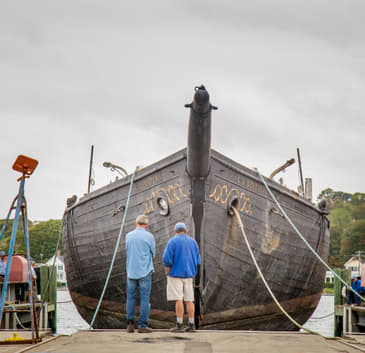
We are very lucky in New England to have an organization like Mystic Seaport and its Henry B. Du Pont Preservation Shipyard, the first shipyard in the nation dedicated to the preservation of historic vessels, both large and small. Join us on this episode of ATB as we talk with Walt Ansel, Director of the Henry B. du Pont Preservation Shipyard, about their ongoing restoration of one of the last remaining Grand Banks fishing schooners in existence, the L.A. DUNTON.
It's free and who doesn't like free stuff?!
[00:00:25] Welcome back to Around the Buoy, broadcasting from the East Passage Boat Ride Studios. I'm
[00:00:30] Carter Richardson and I'm here with Tyler Fields of Tyler Fields photography. Tyler,
[00:00:36] greetings a mid-May greetings to you my friend. Well, I mean it's, it's we're in it man.
[00:00:43] Springs here. My allergies are going nuts. The red socks are barely five, not even 500
[00:00:48] at this point. We're right on track. This is like, this is like the talking heads
[00:00:53] that same as it ever was. Same as it ever was. Same as it ever was. Yeah. Yeah. But now that
[00:00:59] you find yourself kind of out of the, can you believe that I wasn't aware of the talking
[00:01:03] heads until like two years ago? I truly that that does not make sense. Tyler,
[00:01:09] that was a life changing event for me when I, when I realized who they were and how
[00:01:13] much I enjoy their music. And another one, Huey Lewis in the news. Oh, shut the front
[00:01:18] door dude. I'm telling you, other than back to the future as of like two days ago, I became
[00:01:26] a huge Huey Lewis in the news van.
[00:01:28] All right. So we're going to jump in the way back machine, Tyler Huey Lewis in the
[00:01:31] news. They were on their sports tour. I've, I, this is somewhere in the early 80s, but
[00:01:37] in the old veterans Memorial Coliseum, the Madhouse on McDowell where the Phoenix
[00:01:44] Suns played. That's where I saw my first concert with Lord Dingman, the Huey Lewis
[00:01:49] in the news. And I'm telling you Lord Dingman, Lord Dingman. Yes. Let's not make
[00:01:55] maybe Laura as a listener. So let's not, let's not make fun of her Laura or Lord
[00:02:02] Laura with an A. I don't know if that makes it any better.
[00:02:06] But I Huey Lewis and then they came in actually played here in Newport on base at
[00:02:15] the Naval War College. They used to do an end of the summer concert. And back in the
[00:02:20] day, like 10, 15 years ago, they would bring in actual acts. I want to say like the
[00:02:25] pretenders came, but Huey Lewis came and hit after hit after hit after it. The
[00:02:35] concert was nothing but amazing music. Yeah. I can't say anything bad about them.
[00:02:41] No, why would you want to do the sports album? The four album is unbelievable
[00:02:48] packed with hits. It's so good. God, man. I did not expect the podcast to start
[00:02:54] out this way. The best ones never do.
[00:02:59] One of my favorite things in springtime, you know, a ton of painting and
[00:03:03] varnishing happens. And so what's great about that is that for the most part,
[00:03:09] it's just sanding a boat or sanding a trance or whatever. You don't really have
[00:03:12] to think all that much and so you can listen to stuff. So I use it as a really
[00:03:17] good tool to catch up like read books we've talked about in the past, but
[00:03:20] also to catch up on podcasts and a friend of ours, a gentleman named Skip
[00:03:27] Matos. He reached out to me, Tyler, and he let me know that not only is he
[00:03:33] listening, but he is binge listening as he's getting his boat ready for the
[00:03:38] water. Like what do you mean by binge listening? Like sorry, he's been he's
[00:03:43] binge listening to around the buoy. No, no, no, I understand that. But like
[00:03:47] what does that mean? Is just like from the last episode when he's going
[00:03:50] back, like no, he started at episode one way back in 2017. But this is pre
[00:03:57] Tyler. This is hardly before this is like when I didn't even know you, Tyler.
[00:04:01] And with Helena and then he's making his way up to current day.
[00:04:09] So I think he said he's on single handed sailor. I can't remember which
[00:04:13] one that is, but he's been he's been working late at night because I mean
[00:04:18] he has a real job and so he goes to the boat at night and works on the boat
[00:04:21] at night. So he's been listening to a ton of around the buoy and Skip,
[00:04:26] we appreciate you. You might be listening to this and it's now fall and
[00:04:31] you're getting the boat. He's got some catching up to maybe like next spring
[00:04:34] he might listen to this one.
[00:04:37] He might be a year.
[00:04:41] Yeah, I know he's involved in a few different boats, but he has one
[00:04:47] of the boats that I daydream about constantly. He's got a Seaway 21 with
[00:04:52] this perfect little Dodger on the front. It's such a cool boat.
[00:04:57] It'd be a good photo boat, Tyler.
[00:04:58] That's what I'm saying.
[00:05:00] Maybe you should talk to Skip.
[00:05:03] Well, when he listens to this in spring of 2025, we can have a conversation.
[00:05:07] Yeah, give Tyler a call. Give Tyler a call.
[00:05:11] Well, speaking of boats, I know I think it might have been the last
[00:05:15] episode. We kind of got into this bad rut of mentioning cruise ships about
[00:05:21] every episode and none of the stories were good.
[00:05:25] Yeah, I think we actually ditched a couple of our news stories because it
[00:05:29] was just more cruising crap. More people throwing up or ignore virus.
[00:05:34] I think that this one was just too good to pass up.
[00:05:38] So we're going to mention it, but I don't know how to characterize it
[00:05:42] between is this a good story or a bad story?
[00:05:45] Well, I think we might have to wait for our news topics to discuss and let
[00:05:50] let the listeners decide if it's a good story or a bad story.
[00:05:53] I mean, you've already signed up for it, right?
[00:05:57] I don't have the cash or that kind of course.
[00:06:00] I mean, I guess you could you could do the cruise math and you could
[00:06:04] justify the cost of the ticket because of all the money you're saving on close.
[00:06:10] There you go. A little teaser, if you will.
[00:06:13] And so along with more cruise ship news, we do have yet another update
[00:06:17] on our friend Charlotte the Ray, the Manta Ray or whatever that thing is.
[00:06:22] I got to tell you, Charlotte, I got to tell you, Charlotte, I got to tell you,
[00:06:25] Tyler, you don't know Charlotte could be listening to when we first
[00:06:30] talk about Charlotte and this goes back to I think the Sarah Stone episode.
[00:06:34] So like just three episodes ago, about three, two and a half months ago.
[00:06:38] There's no way in Hades.
[00:06:39] I thought that this story would have a run of three episodes.
[00:06:45] Well, it's what it does.
[00:06:47] It's just a gift that keeps on given.
[00:06:49] This is our Frenchman barrel again.
[00:06:53] It's a gift that keeps on given, but nothing's happening.
[00:06:56] There again, no update and the natives are getting restless.
[00:07:01] We're about to go Frankenstein with pitchforks and Tiki torches.
[00:07:05] I don't, I don't mean to.
[00:07:08] I don't mean to be boastful, but I kind of called BS on this the first time around.
[00:07:14] And I have so far I seem to be seem to be on the right track.
[00:07:18] Well, we'll see if there's any scientific reason for all of this happening
[00:07:23] before we get to those news topics, we're going to sit down and talk to
[00:07:27] Walt Ansel. Many of you might recognize the name or the either friend
[00:07:31] of the podcast or a follower of East passage would know Walt Ansel as he is
[00:07:37] the designer of the East passage 24, but you might not know that he is also
[00:07:42] the director of the Henry B. DuPont preservation shipyard at Mystic Seaport.
[00:07:47] And the shipyard has been one of the busiest places on the East coast
[00:07:53] for many, for many reasons, because one, they can only handle.
[00:07:58] They're one of the few places that can handle massive restorations
[00:08:02] ships like the Mayflower, the Whaling Ship Morgan.
[00:08:06] And they've just started, I'd say, within the last like seven or eight months.
[00:08:11] They just started a restoration of a fishing scooner called the L.A.
[00:08:14] Dutton and we're going to be sitting down to talk to him about the history
[00:08:17] of the boat, the history of fishing scooners.
[00:08:21] It's a fascinating talk.
[00:08:23] It's I mean, it has everything that that I know you and I love.
[00:08:26] We've got wooden boats, scooners, history, commercial fishing.
[00:08:31] I mean, it's it's got it all.
[00:08:34] If he only would break out into a sea shanty, I think we would really
[00:08:39] satisfy the listeners.
[00:08:41] I mean, as much as I am a fan of maritime history and just nautical culture,
[00:08:48] I'm just going to have to stop at sea shanties.
[00:08:51] Huzzah.
[00:08:53] We'll be right back with Walt after this short break.
[00:09:17] New England is full of living museums that transport you back to a different era
[00:09:21] to get a sense of what life was like hundreds of years ago.
[00:09:24] Places like Sturbridge Village, Plymouth's Plantation and Mystic Seaport
[00:09:28] are practically a requirement for all school age kids in the Northeast
[00:09:32] to visit at some point.
[00:09:33] But what separates Mystic from the rest of this group is that the Seaport
[00:09:36] is also an active working museum dedicated to restoring
[00:09:40] and caring for the mighty wooden ships that were the backbone of ocean going
[00:09:44] trade and commerce in the 19th century.
[00:09:46] With no exaggeration, it's fair to say that there is a ton of stuff going on
[00:09:50] at the Seaport right now.
[00:09:52] And one of the restoration projects that is in the beginning stages
[00:09:55] is the fishing schooner, L.A.
[00:09:57] Dutton, and we are joined by the director of the Henry B.
[00:10:00] DuPont Preservation Shipyard, Walt Ansel, to discuss the Seaport's
[00:10:04] latest undertaking.
[00:10:05] Walt, welcome to Around the Bowie and thanks for coming on the show.
[00:10:08] Hey, Carter, Tyler.
[00:10:09] It's with great pleasure to talk to you about the Dutton.
[00:10:14] Thank you. Fantastic.
[00:10:16] Well, we'll start.
[00:10:17] I mean, so tell us about the Dutton, her origins.
[00:10:21] What was she originally built for?
[00:10:23] Who designed her? Where was she built?
[00:10:26] Well, the L.A.
[00:10:27] Dutton was a typical late stage Gloucester fishing schooner.
[00:10:34] She was and by late stage, I kind of mean that
[00:10:38] schooners were fading when she was designed and built
[00:10:41] and trawlers were pretty much filling the place of the
[00:10:47] the long lining that was done out of the Dorees.
[00:10:50] Dutton was basically a mothership, but she was she was built
[00:10:54] in 1921 in Essex, Massachusetts by the story yard, A.D.
[00:11:00] Story and had been designed by Thomas MacManus,
[00:11:05] who was kind of the preeminent classic Gloucester fishing
[00:11:09] schooner designer.
[00:11:11] She was modeled on a vessel named the Joffrey that was built
[00:11:16] seven years before.
[00:11:18] And in 1921, Dutton's sister ship,
[00:11:22] the America was built also.
[00:11:24] So pretty close as a carbon copy as you can get to Dutton.
[00:11:28] What was the fishery that she was kind of designed and purpose built for?
[00:11:32] That's it. That's a great question.
[00:11:34] She was a grand banks Dory trawler, as we call her.
[00:11:39] And she was built for Captain Felix Hogan,
[00:11:44] Newfoundlander transplanted here.
[00:11:47] And he specialized in the summer halibut fishery.
[00:11:51] That was kind of his his expertise.
[00:11:55] And then in the winter time, they would fish for cod and haddock,
[00:12:01] what we kind of generally call ground fish.
[00:12:04] But if you've the area they fished was
[00:12:08] quite a ways from Gloucester and Boston.
[00:12:11] And if you have watched the Perfect Storm or read any of Linda Greenlaw's books,
[00:12:16] this is the grounds that they fished with these Gloucester fishing schooners
[00:12:21] and voyages were anywhere from a month to six weeks long
[00:12:27] and no engines so all under sail.
[00:12:30] Yes, she was built kind of at that turning point
[00:12:33] where marine engines were becoming commonplace.
[00:12:36] And I think she was one of the last boats built in Gloucester,
[00:12:41] at least of this type that didn't have an engine.
[00:12:43] What was the purpose for that?
[00:12:45] Because it was it was available at the time that she was built.
[00:12:48] Well, that was that had to do with racing.
[00:12:51] And Dutton was built with the shaft log
[00:12:54] and an aperture, you know, in her backbone.
[00:12:57] And that was all plugged up basically.
[00:13:00] And they tried racing her for about a year
[00:13:03] and when it was apparent that she didn't have the hull shape or the size.
[00:13:09] You've got to realize that the Canadian schooners were a good 15 feet longer.
[00:13:14] So the smaller vessels in the 120 foot range like L.A.
[00:13:19] Dutton really didn't have a chance to compete.
[00:13:21] And then because of economics and the price of building the schooner,
[00:13:27] they put the diesel engines in them almost right away.
[00:13:30] When they proved not to be successful racers
[00:13:33] and, you know, turn them into working fishermen
[00:13:36] that were basically motor sailors.
[00:13:40] And that was only a couple of years, three or four or five years
[00:13:42] after she was originally built, right?
[00:13:44] I think it was only about a year and a half, to be honest with you.
[00:13:47] Yeah. Yeah.
[00:13:49] She clearly showed that she didn't have her the chops.
[00:13:53] Well, the interesting thing is if you compare her to Elsie,
[00:13:57] who was McManus's kind of best known smaller racing schooner,
[00:14:03] she actually did try to race against Blue Nose,
[00:14:06] even though she was a lot smaller.
[00:14:08] And she she did for her size relatively well,
[00:14:14] but it was both for both.
[00:14:15] There was no rating.
[00:14:17] And I'm not convinced that the shape of Elsie and Dutton
[00:14:23] are that different.
[00:14:24] So I think a lot of it boils down to the skipper
[00:14:27] and the training of the crew and all that.
[00:14:30] And I don't, I don't have the impression
[00:14:32] that Felix Hogan was a go getter racing skipper.
[00:14:36] He was a safe and very successful fisherman.
[00:14:39] And there's a lot to be said for that.
[00:14:41] I was going to say in the grand scheme of things,
[00:14:43] that seems probably like a better trade off overall.
[00:14:46] Yeah. Yeah.
[00:14:46] It's really interesting to, you know,
[00:14:49] when you talk about these big schooners
[00:14:51] that they that they did race them,
[00:14:53] it seems really funny that you would have a,
[00:14:56] I mean, I was trying to think of an analogy
[00:14:58] and I've seen, you know, like school bus racing
[00:15:01] where on big dirt tracks where they just race
[00:15:04] a couple of school buses together.
[00:15:05] And that's kind of what I would equate this to.
[00:15:07] It's, is it, is it odd that that's what they did in their off time?
[00:15:11] What about lobster?
[00:15:12] Lobster boat races up in Maine.
[00:15:14] There's a lot of there.
[00:15:15] That's exactly it.
[00:15:16] And so was it odd that that they did this?
[00:15:19] I mean, would they literally just kind of offload
[00:15:22] a whole catch one day and then say,
[00:15:23] Hey, let's go out and race.
[00:15:24] Or would they switch out and put new sales on that kind of stuff?
[00:15:28] Well, it's interesting.
[00:15:29] There there's some national pride involved here too,
[00:15:33] because, you know, the Canadians were very successful at this.
[00:15:37] And advice, as I said, their schooners were larger
[00:15:41] than ours were generally.
[00:15:43] But in the
[00:15:46] in the early 1920s, racing fever kind of gripped
[00:15:51] New England and the Maritimes.
[00:15:53] And the same winter that
[00:15:57] Dutton was built,
[00:16:00] the the Mayflower
[00:16:03] Starling Burgess design was built to race also
[00:16:08] against the Blue Nose, which is also built in 1921.
[00:16:12] So there was a lot going on here.
[00:16:14] But the way it worked is you had to make a voyage under sail,
[00:16:19] fishing on the banks to qualify to race.
[00:16:22] And the Canadians actually disqualified
[00:16:27] Mayflower because she they felt that she was
[00:16:31] a yacht and not a working vessel, even though she had made a trip
[00:16:35] successful trip to the banks.
[00:16:38] A little bit of politics and then there somewhere, huh? Yeah.
[00:16:42] So you mentioned that this was kind of the end of the schooner era.
[00:16:46] But up until then, these were the go to boats.
[00:16:50] I mean, if you were going to go fishing off shore, this this gloss or schooner,
[00:16:54] there was nothing better.
[00:16:56] What was it about these boats that made them that made them so special?
[00:17:00] What was the qualities that made them so ideal for this kind of fishery?
[00:17:06] Boy, that's a.
[00:17:08] That's a that's a hard thing to address and just just a few words.
[00:17:12] But I'll try. I'll take a hack at it.
[00:17:15] Um, you got to realize that the design evolution, Tyler, happened over a long period of time.
[00:17:25] The fisheries on grand banks and Georgia's bank,
[00:17:29] the oldest industry in America.
[00:17:33] You think about it and that, you know, basically fed the young nation.
[00:17:36] So by. Oh, I don't know about 1830.
[00:17:41] We were fishing, Georgia's and I guess there were trips.
[00:17:46] Some trips being made to the grand banks at that point.
[00:17:48] But it was it was a big deal.
[00:17:52] And the losses were pretty horrific.
[00:17:59] So the designs were studied very carefully over the years,
[00:18:03] and they evolved to be safer and safer as time went on.
[00:18:06] But here you take up a vessel with a massive sailing rig
[00:18:11] and inside ballast and then cargo that that varies in in amount.
[00:18:18] So you have a shifting weight constantly.
[00:18:21] So the the design is is tricky and kind of a genius thing
[00:18:27] to be able to achieve to get it to work.
[00:18:30] Um, the the Dunn's.
[00:18:34] Summer rig and which would have been the racing rig.
[00:18:39] I got a few numbers here that are kind of staggering.
[00:18:42] She was 120 feet on deck.
[00:18:45] Load, waterline was 94 feet beam 25, 6 and her draft was 13 to 15 feet,
[00:18:52] depending on cargo and summer racing rig was 8000 square feet.
[00:18:59] And when you think about no winches, all blocks and tackles to handle this
[00:19:06] and a crew of typically 22 to 24 men,
[00:19:13] all working in coordination to raise that main sole and handle it.
[00:19:20] The as I said, maybe mentioned 3500 square foot main sole,
[00:19:24] the main boom was 76 feet long and the main gap 45 feet.
[00:19:31] And this is a and you are on top of the ball on top of the main
[00:19:36] top, Miss, you'd be 118 feet off the water.
[00:19:40] And these aren't modern sail materials.
[00:19:42] This is heavy duty canvas.
[00:19:46] So that you can imagine what it was like when it was wet.
[00:19:51] Yeah. But it's interesting because what we
[00:19:54] did in a bunch of episodes ago, we talked to the curator of the Cuddy Sark
[00:19:58] Museum in England and they talked about how speed was king.
[00:20:03] And does the, I mean, obviously they were racing and they wanted to be fast,
[00:20:07] but does the speed of the schooner.
[00:20:09] So as soon as you catch your, your hall, you got to get in and
[00:20:12] apport as quickly as possible.
[00:20:14] It did. I mean, the speed of the schooner, that obviously takes
[00:20:19] a priority or the skewer to get the trade or get the goods
[00:20:23] into the, into port.
[00:20:26] Lot of unofficial races home.
[00:20:31] Yeah.
[00:20:32] But also the other interesting point you brought you, you said earlier is that
[00:20:36] you didn't, the style in which that you fished off the dungeon
[00:20:40] is that you went out to sea and then you sent men out in Dory's.
[00:20:45] That's right.
[00:20:46] So you're in the middle of the Atlantic in the wintertime
[00:20:50] and an open Dory rowing out to lay, lay lines.
[00:20:54] You talk about hearty people.
[00:20:58] And the days were tremendously long because you got up before dawn
[00:21:04] to bait the long lines with herring.
[00:21:08] And then you set out in the Dory's and you fished all day
[00:21:11] and came back probably around three in the afternoon.
[00:21:17] And then you had hundreds of thousands of fish to cut and clean
[00:21:22] and put away.
[00:21:24] So typically they'd work till after dark and catch about four hours
[00:21:28] of sleep and then back up at it and add it again.
[00:21:31] I can't imagine what the living space folks will smelled like
[00:21:35] after a long voyage.
[00:21:36] A previous crew member from, I believe the fifties, I want to say
[00:21:40] his name was Maurice.
[00:21:42] I want to say Kearney, but I can't remember exactly.
[00:21:45] The museum has done a few interviews with him and he talked about those days.
[00:21:49] His feeling on it now is we did it.
[00:21:52] I don't know how we did it.
[00:21:54] We just did it.
[00:21:56] And his his kind of overview of the days
[00:22:00] and the process of what they do was really, really interesting.
[00:22:03] So that's on the museum's YouTube page.
[00:22:06] It's worth checking out.
[00:22:08] Dutton's fishing career under American ownership was not very long.
[00:22:14] In 1935, she was sold up to Newfoundland in Canadian interests
[00:22:20] and she continued as a long liner and then sort of later on
[00:22:27] in the 40s and 50s, she became a freight boat.
[00:22:31] And in the early 60s, Mystic Seaports started looking at
[00:22:36] good representative Gloucester fishing schooner and heard through
[00:22:42] Irving Johnson and a few others that that Dutton was up in Newfoundland
[00:22:48] still working at this point.
[00:22:51] She was mostly carrying freight, coal and oil from Nova Scotia
[00:22:55] to the outports in Newfoundland and owned by the Buffett Company.
[00:23:00] And Mystic Seaport started negotiations with
[00:23:05] the thought of purchasing her from that company.
[00:23:08] And actually at for the time
[00:23:14] a fairly high price and the vessel was still a viable working
[00:23:18] watercraft, I believe that that they bought her somewhere
[00:23:23] in the vicinity of $30,000 in 1963.
[00:23:28] And the Newfoundland crew together with the few representatives
[00:23:34] from Mystic sailed her down to New London and they delivered her,
[00:23:38] which is very cool.
[00:23:40] But she at this point when you said she was doing carrying freight
[00:23:44] she had turned over to essentially motor,
[00:23:47] a motor vessel at that point, correct?
[00:23:50] Well, she still, she still had her masks and she still had riding sails.
[00:23:54] So I think they used them.
[00:23:57] She had a four cylinder Fairbanks, Morse, crude oil, diesel engine in her.
[00:24:03] And yeah, I have seen pictures of her with the with the sails on.
[00:24:12] The stern had been cut off to kind of a square steamboat stern
[00:24:17] and the Bowsprit had been taken off too for ease of docking.
[00:24:22] In fact, one of the first things Mystic Seaport did at Thames Shipyard
[00:24:26] in New London was to put a schooner style transom on her.
[00:24:32] And then then they brought her up to the museum and rigged her
[00:24:35] as she would have been with a full summer racing rig in the in the 60s.
[00:24:41] What was the for Mystic when they were looking at the
[00:24:44] Dutton and bringing her into the into the yard?
[00:24:49] What was the purpose?
[00:24:50] Was they were they thinking purely as we want to have an example
[00:24:54] of a Gloucester fishing schooner?
[00:24:55] Or was there some other reason for bringing it?
[00:24:58] Were they going to use her as a sailing vessel or just as a snapshot of history?
[00:25:05] I think the early intent was always just as a really good
[00:25:09] representative example of Gloucester fishing schooner.
[00:25:13] And Dutton had a real purity about her,
[00:25:17] even though she had done a little bit of fraying.
[00:25:19] She had mostly fished all her life and that's all she had done.
[00:25:23] And the conversion work that had been done to her was not that extreme.
[00:25:29] You had mentioned that she had had some work done
[00:25:31] and she wasn't quite in the original condition that she was built.
[00:25:34] And she had the the pilot house, the stern had been converted,
[00:25:37] the boughs were gone, the rig was changed.
[00:25:41] At what point did the museum realize that it was time
[00:25:45] for a little bit of restoration work?
[00:25:47] When when did that kind of become a priority?
[00:25:51] I they they got on that right away, which is interesting.
[00:25:57] And Basil Tupland, the master shipwright,
[00:26:00] who put the transom on her at Thames Shipyard,
[00:26:04] he did that before she even was brought up river to the museum.
[00:26:09] They didn't finish the job completely.
[00:26:12] They had it framed, the transom was plank, but the bulwarks were not installed.
[00:26:18] And she lost a little shape at that point, right?
[00:26:22] And I think a little bit, but not much.
[00:26:25] Did they did they do something that they raised the bull?
[00:26:28] Can the the bulwarks a little bit to kind of fake the shape a little bit?
[00:26:33] That's that's a later story that happened at Mystic in the seventies.
[00:26:39] And it's a it's a little bit of a sad story.
[00:26:44] Mystic did not have a way to haul the vessel and support it adequately.
[00:26:49] So they started a rebuild, which we call a retopping in the water.
[00:26:55] And they took off topside planking
[00:26:58] and that accelerated the hogging
[00:27:02] that had already started through her age.
[00:27:05] And and it got away from them a bit.
[00:27:08] So when you were talking about the corrective measures,
[00:27:11] that was done after the seventies restoration
[00:27:15] to try to address the sheer, which is a had
[00:27:22] it became a huge topic of discussion around Mystic.
[00:27:25] And for those that really knew what they were looking at.
[00:27:30] And and in some ways, a bit of a disaster, really
[00:27:35] not good looking at all like her original form.
[00:27:38] So the the current restoration that we've just started now,
[00:27:42] that's one of the major things that we are addressing.
[00:27:46] Put her back into that beautiful seabird look.
[00:27:49] When you when you say hogging, Walt, for those who don't understand that
[00:27:53] that concept, what is hogging on a ship like this?
[00:27:57] That's when the midbody of the vessel is
[00:28:00] is basically pushing up and the ends are drooping.
[00:28:04] And the shear line, which is the the curve of the rail
[00:28:07] or the edge of the deck becomes flattened.
[00:28:11] Or in a worst case scenario, can kind of assume
[00:28:15] a mustache shape that's humped up in the middle and curved at the ends.
[00:28:20] For let's say, that's kind of where we were in the seventies.
[00:28:23] And we tried adjusting the height of the top rail.
[00:28:27] But the hull was weak enough that this was kind of a little bit too late.
[00:28:31] Really didn't correct the problem.
[00:28:33] Yeah, for listeners who can't see the video, Walt has a tremendous mustache.
[00:28:40] If we're going to use that as a unit of measure that should be noted.
[00:28:43] But what is the I think I've read a couple different numbers,
[00:28:47] but it was more than three feet drop on either.
[00:28:51] Yeah, it was a little over three feet, which for a vessel
[00:28:55] it's 120 feet on deck. That's that's pretty significant.
[00:29:00] Yeah. When did when did it come about that?
[00:29:03] We were going to undertake the current restoration.
[00:29:06] How long ago, how long has this been in the works for the museum?
[00:29:11] I would say we knew that we absolutely had to do something,
[00:29:16] but we didn't get the the bandwidth really
[00:29:20] to deal with it until about three years ago.
[00:29:24] The plan was started, but you had mentioned that the shipyard
[00:29:30] moving a boat like this isn't isn't easy.
[00:29:32] And it's not you mentioned in the 70s, it wasn't easy in the 60s.
[00:29:36] It wasn't easy even today.
[00:29:38] It's not an easy process and the busy
[00:29:43] and the amount of work that the shipyard is currently doing.
[00:29:45] You didn't have space to haul her
[00:29:48] and on the railway that you would normally haul her.
[00:29:50] So the plan was made that you would lift her with a crane.
[00:29:54] And luckily enough, you got to practice on the coronet down at Iris.
[00:29:59] Using two cranes to lift her up onto the bar.
[00:30:01] So you were able to get one under your belt.
[00:30:04] How did that process go at Mystic?
[00:30:07] Because there was a there was another issue as well.
[00:30:09] You didn't have a suitable pad to set her on before you even lifted, correct?
[00:30:15] Yeah, that was a that was an amazing effort to be involved in.
[00:30:22] As you said, we sort of had the dry run.
[00:30:24] We had a thousand ton crane barge in Newport
[00:30:28] and we had rented rigging and lift assembly
[00:30:34] from Texas or was Oklahoma, excuse me,
[00:30:39] that were steel spreaders, big cables,
[00:30:43] triplates and all that and then big nylon web straps.
[00:30:48] And Coronet was a little bit lighter than
[00:30:52] Dunton and more of a straight type of haul to deal with.
[00:30:57] It had less rocker to it, but without too much adjustment,
[00:31:02] we were able to use all the same rigging for hauling Dunton out.
[00:31:07] And we had rather than a barge based thousand ton crane,
[00:31:13] we had for Dunton two six hundred ton
[00:31:16] shore based lead hair cranes that they brought in and assembled
[00:31:21] and our visitor parking lot across the street
[00:31:25] and drove them over and put them on site at the north end of the shipyard.
[00:31:30] And then we did the lift from the water right there
[00:31:33] and flew the schooner basically between the cranes
[00:31:36] and just set her right on the other side.
[00:31:39] So it was it was a close, close fitting thing.
[00:31:44] And your question about the ground is really interesting.
[00:31:49] The shipyard is built on fill and we were concerned
[00:31:54] about the fill at that north end supporting her weight.
[00:31:58] So we did a bunch of test drilling and sure enough, down to 20 feet,
[00:32:02] we hit mud and we realized that we had either poor slab
[00:32:08] or come up with some sort of alternative support
[00:32:11] the way to the ship for the restoration.
[00:32:13] So what we the most economical
[00:32:17] way turned out to be driving 24 pilings
[00:32:22] down to a certain resistance, almost like we were building a dock
[00:32:27] and then cutting them off in the bottom of a trench
[00:32:31] and then pouring a concrete spine or kind of backbone
[00:32:36] to land the ship on.
[00:32:38] And that worked out very, very well.
[00:32:41] Is this something that you're you're going to be able to utilize
[00:32:43] moving forward when this restoration is done?
[00:32:46] Absolutely.
[00:32:47] There's talk about putting Roseway on there
[00:32:50] when we're done with that.
[00:32:54] Was there any worry in the difference between the coronet
[00:32:59] move and the Dutton move is that the coronet was at this point
[00:33:02] the hull and the backbone is fully restored?
[00:33:04] Was there a concern of about a hundred year old schooner being
[00:33:07] lifted by two cranes that she might just fold in half?
[00:33:10] And it might this whole thing might be a end really quickly
[00:33:14] and badly?
[00:33:15] Well, there was absolutely.
[00:33:17] And we were very careful to take the strain with the cranes
[00:33:23] and and lift her just a bit.
[00:33:26] And Chris Kiseric, my boss, one of our vice presidents,
[00:33:31] he was sighting from forward and I was sighting from Aft
[00:33:35] and it was pretty astonishing.
[00:33:37] The hull was so well supported by the straps
[00:33:41] that we saw no movement at all.
[00:33:43] We had a few shipwrights down below that said they heard
[00:33:46] a little bit of creaking, but nothing of significance.
[00:33:50] So we got very lucky.
[00:33:53] That's amazing. Please.
[00:33:54] Yeah. So the video is also on Mystic's website.
[00:33:58] The video of them hauling this thing up with the two cranes
[00:34:01] and really truly the ballet you guys did as you threaded
[00:34:05] the needle and put her on down is truly remarkable.
[00:34:08] She was about 150 long tons in that at that point.
[00:34:14] What was pouring that when they lifted her?
[00:34:17] She was a little less than that.
[00:34:18] I think she was around 120.
[00:34:21] We had we had debalasted
[00:34:23] Dunton before that lift and lightened her up
[00:34:26] just as much as we could.
[00:34:28] So now that you have the boat up on shore,
[00:34:30] let's talk a little bit about the restoration.
[00:34:32] Is this a cosmetic restoration to be used
[00:34:35] just kind of as a dockside exhibit?
[00:34:37] Or is this going to be a full comprehensive restoration?
[00:34:41] Is is there any chance that we may see her
[00:34:44] sailing again in the future?
[00:34:45] Like we saw with the Morgan?
[00:34:48] Our hope is to sail her.
[00:34:51] It's it's it's an extraordinary vessel.
[00:34:54] And I think those of us who have been
[00:34:59] taking care of her and watching her for so long,
[00:35:01] that would be the ultimate thing to to to be able to do that.
[00:35:06] It's a more compelling reason
[00:35:10] for donors to give money to the project, too,
[00:35:12] as we found out with Morgan.
[00:35:15] And she she probably would be a little bit easier
[00:35:20] to sail than Morgan with the Mystic River.
[00:35:23] We were limited somewhat with depth and and Morgan
[00:35:27] to have her ballasted to a safe sailing depth.
[00:35:31] It's it's too deep for the river.
[00:35:32] We had to do that in New London, but with the Dunton
[00:35:36] wouldn't be the case.
[00:35:37] We could ballast her and and take her in and out of the river
[00:35:41] without too much trouble.
[00:35:43] The Dutton has been restored and modified
[00:35:46] numerous times in her life as of as she sits now as you're
[00:35:49] restoring her. How much of her is original?
[00:35:54] That's a that's a tough question, but I would just
[00:35:59] say maybe 30 or 40 percent is original at this point.
[00:36:05] Yeah. And then what period because she's gone through
[00:36:07] the different kind of transformations, what period are
[00:36:09] you restoring her to? You're doing the original schooner.
[00:36:12] The original as she was in 1920.
[00:36:15] 1921, that's 21. Yeah. Yeah. Yeah.
[00:36:18] Yeah. Nothing about the marine world is cheap.
[00:36:24] And when you're talking about a ship of this size,
[00:36:26] the numbers can quickly get out of hand.
[00:36:29] Funding for a project like this has to be difficult.
[00:36:31] How is the museum approach this this Herculean task?
[00:36:35] The.
[00:36:38] The advancement team is really on it and working hard
[00:36:43] and courting courting donors.
[00:36:46] I've been talking to donors also to try to do my part
[00:36:50] to help to tell the back story.
[00:36:53] And I didn't completely answer your question from earlier.
[00:36:57] It is going to be a complete restoration.
[00:37:00] There is no question because she has lost so much shit
[00:37:04] and we need to we need to put her back to looking
[00:37:08] as she did in 1921.
[00:37:11] So if we're lucky, we'll save maybe a fifth of what could
[00:37:15] be determined to be original structure,
[00:37:19] but that'll probably be about all.
[00:37:22] We have pushed the bow up with 50 ton hydraulic jacks
[00:37:27] three feet.
[00:37:28] We've loosened her up that much forward and
[00:37:32] that's pretty amazing.
[00:37:35] We don't really know about many efforts of bending
[00:37:39] 120 foot schooner.
[00:37:41] So we think that we're kind of pushing the envelope
[00:37:45] here in museum restorations and it's pretty darn exciting.
[00:37:50] It's I think it's significant to at least point out
[00:37:55] these vessels when they were built, they were not built.
[00:37:58] And this thing we see this with all the classic
[00:38:02] boats that come into the shop.
[00:38:03] These boats were not built to last 100 years.
[00:38:06] They were they were built as quick as possible to get out.
[00:38:09] So thinking about a 100 year old ship and the condition
[00:38:15] that she's still floating alone is pretty spectacular.
[00:38:19] It is it is.
[00:38:21] And you're absolutely right.
[00:38:22] They were an economy build probably I think the average
[00:38:26] life was only about 12 years, which is really horrific.
[00:38:30] But they the intent was to get them to last about 25 years or so.
[00:38:36] They were trunel fastened with wooden nails, which actually is
[00:38:40] a very good fastening system lasts a long time.
[00:38:45] But the the rest of the fasteners in the hall, the butts
[00:38:49] and the hanging fasteners were all galvanized iron.
[00:38:53] And that as you know, Carter being in the business,
[00:38:56] that's got a life of about 25 or 30 years.
[00:38:59] And then the tannic acid in the oak just eats the fastening away.
[00:39:03] And you're left with a very weak and poor
[00:39:08] situation, often the wood being rotted by the iron fastener also.
[00:39:15] So I know I hate it when people come into the shop and ask me
[00:39:19] about timelines and length and schedules and all that kind of stuff.
[00:39:22] But Walt, I do have to ask what is the timeline of this project?
[00:39:26] What are you guys? What is mystic thinking?
[00:39:29] Well, we're thinking anywhere from seven to ten years.
[00:39:33] And we have a very small crew on there right now.
[00:39:35] We have three full time shipwrights and we've got amazing volunteers.
[00:39:41] We've had interns from Iris working on the vessel.
[00:39:45] But the way I see it is we have the first new keel piece
[00:39:51] that slated to go in in the next couple of weeks.
[00:39:54] And I think there are going to be eyes on the project and momentum is going to build.
[00:39:59] And I think what we're going to get is a bigger and bigger crew as we move forward.
[00:40:07] I put together an advisory committee and
[00:40:11] been just amazing.
[00:40:12] Maynard Bray, who worked on and was a steward of the vessel back in the 70s,
[00:40:17] is still with us and is on my committee or our committee.
[00:40:23] And what an amazing thing to have him as a resource.
[00:40:28] Taylor Allen, Nat Benjamin,
[00:40:32] people that have been working on large timber vessels in New England for a long, long time.
[00:40:37] We did not want to make
[00:40:40] our decisions without some sort of bedding.
[00:40:44] And it's been awesome.
[00:40:47] A really, really great resource.
[00:40:51] So the shipyard, it's philosophy and its mission isn't just to save historic vessels,
[00:40:58] but it's also to save the skills and that way of life.
[00:41:02] So are people going to be able to visit the Dutton during this process
[00:41:06] and to see the work that these carpenters and shipwrights are doing
[00:41:10] and learn about the process as she goes?
[00:41:12] Absolutely. And that is key.
[00:41:16] I mean, it's part of our mission, just as you mentioned, is to preserve the trade.
[00:41:21] And we are we're closely involved with the International Yacht Restoration School
[00:41:28] in Newport. We have a number of graduates working on our projects,
[00:41:34] working in the Yard of Shipwrights.
[00:41:37] There are certain people that go through that program
[00:41:40] that decide they really like the heavy timber work in the marine world.
[00:41:46] vessel restoration or building.
[00:41:49] I kind of like to think of what we do almost as if it's the post and beam version of boat building.
[00:41:57] But what an amazing resource to have.
[00:42:00] And yes, absolutely, the vessels got to be kept open.
[00:42:05] We're in the process of installing wheelchair access to the inside of the hull,
[00:42:10] which is unprecedented. We've never done that before.
[00:42:14] And we have a tower. People can walk up and get on deck and look down into the
[00:42:21] open bow now, which is open deck beams and looking right at the frames kind of a skeleton appearance.
[00:42:30] The other thing that's very hard is to keep her looking as a schooner hull while we go through
[00:42:38] this whole process. So it might take a little bit longer and we might do things a bit slowly,
[00:42:45] but we'll always have that amazing profile and her presence as a Glosterman rather than
[00:42:53] cutting off large chunks and throwing them on the ground and building them new.
[00:42:59] It's important to have that when I say model, but it's important to have the
[00:43:05] fixture there in the yard for people to see, to know that what's going on. I completely understand.
[00:43:10] Yes, it might take longer, but it really does. It lends to the effect of how we're going to get
[00:43:18] this ship restored. How can listeners keep up with the progress on the Dutton and also
[00:43:23] what's going on at the Henry B. DuPont preservation shipyard? Come by and see us.
[00:43:29] The wooden boat show. Yeah. End of June. Wooden boat shows. One time.
[00:43:33] Yeah. The yard hours, the crew works seven to three thirty five days a week.
[00:43:42] As far as we know, we're the only museum shipyard in the country that's open to visitors. You can
[00:43:49] walk right through. You can watch our sawyers turning white oak logs into timbers on our sawmills.
[00:43:57] You can go up in the gallery and the main shop and look down and see shipwrights fitting pieces
[00:44:03] into the smaller projects inside the shop. So that access is extraordinary, I think.
[00:44:11] And also one of the things that's amazing, you think of an old shipyard where it's
[00:44:17] wooden boats and it's very antiquated, but your social, the mystic social media
[00:44:22] is really on par with, I mean, I think you guys are the only shipyard like big boat shipyard that's
[00:44:29] on TikTok. Walt, I mean, are you aware of that? Yeah, I'm kind of 19th century with that, but I
[00:44:35] understand that we are pretty well represented. Yeah. You guys are on YouTube, Instagram,
[00:44:40] TikTok. It's pretty, it's pretty across the entire sphere of the social medias. Well,
[00:44:46] thanks, Walt. This has been a fascinating talk about the Dutton. I really appreciate your time
[00:44:50] and spreading the knowledge on the vessel. Absolutely, Carter. And please come by and
[00:44:57] see what we're up to. It's a fascinating place and very busy these days. Yeah, it boggles my mind
[00:45:05] that just as you were describing, you can as a tourist walk on the grounds and watch
[00:45:11] the carpenters and the shipwrights do all actually do the work. There's nothing else
[00:45:17] like it in the world. That's right. That's really cool. All right. Well, thank you again, Walt. Have
[00:45:21] a great day and we'll talk to you soon. YouTube take care fellas. Welcome back to Around the Buoy.
[00:45:57] We say it about all of our guests, Tyler, but that is just fascinating. Yeah. I mean, it's
[00:46:05] a boat that, you know, I've known of. I visited her at the seaport many times. I mean,
[00:46:12] just hard to miss. She's really a pretty boat. So it's exciting that after all this time that
[00:46:19] they're able to put in some time and capital into ensuring that she's going to last for another
[00:46:27] 104 years. What I've, you know, because she's obviously going to mystic, she's obviously doxide.
[00:46:34] Just kind of sitting there waiting for her to come out. But when she's, I was up there in,
[00:46:42] I want to say like January picking up some wood for a boat and I was right next to the
[00:46:50] Dutton and to see it out of the water was really impressive. But then to see it,
[00:46:56] what they're doing to the shear line to get rid of the hog as we torture this boat back into
[00:47:02] shape is really impressive. They have a long piece of plywood with foot markers on it, like,
[00:47:09] you know, every six inches markers on it and the amount that they are moving this boat is truly
[00:47:14] remarkable. It's amazing that the things that the ship here does because I'm used to seeing boats
[00:47:20] on a much smaller scale, you know, big boats are 40, 50 feet, which are half less than half
[00:47:29] the size of these boats. And the scale of everything is so impressive, you know, frames are
[00:47:34] frames at that point. They're huge. And, you know, it's not just a quick and easy thing to reframe
[00:47:41] a boat like it is 12 and a half, you know, relatively one person can kind of do it
[00:47:48] piece by piece. But, you know, the size of everything is so much larger.
[00:47:52] Yeah, we, it's really impressive. And to see it again up close and see a 100 foot ship
[00:47:59] with these frames that are just these massive sawn frames that you're,
[00:48:04] yeah, again, they're, you're talking about cranes moving into place. It is, it is a very,
[00:48:10] very impressive, impressive feat. And I mean, the, I will stress to our listeners,
[00:48:17] do yourself a favor and search online them lifting the Dutton out of the water. Because
[00:48:25] that was, and they truly, it was a ballet. They had two cranes and they were on either side of the,
[00:48:32] of the, of the yacht or the ship. And they had to thread this thing through the needle. It was,
[00:48:38] it was ballet. I'm telling you, it was so impressive. And, you know, the other aspect
[00:48:44] that I find really impressive is that throughout all of this, it's still an open museum. And
[00:48:50] you can go in and watch every day, you can go in and see what they're doing. And Walt had mentioned
[00:48:56] that this is the first time that it's been handicap accessible, a restoration like this where
[00:49:05] wheelchair accessibility even into the hole now to watch the work being done, which I think is
[00:49:10] amazing. It's, it's really incredible. It takes a really difficult tasks and makes it
[00:49:16] even more difficult having people be able to, you know, work in and around public access like that.
[00:49:23] But it just goes to that mission of we're not just preserving the boats, but we're preserving the,
[00:49:28] the skills and, and the, I think I said maritime tradition, but those careers of
[00:49:34] ships, carpenters and things like that, that we would be sorely missing if places like the
[00:49:40] Seaport weren't around. Yeah, big time. I do feel for, Walt had said like that, that they're just
[00:49:46] two shipwrights working on this ship right now. Man, that's got to be a pretty lonely job. Just
[00:49:51] the two of you in this boat that is seriously falling down all around you and just like,
[00:49:56] all right guys, when is help coming? Because this is going to be a 10 year program and
[00:50:03] then another 20 if it's just the two of us, those poor guys. A big shout out to you guys.
[00:50:09] Yeah. But how cool would that be in the 20, 20, mid 2030s to see that boat back out in the Atlantic
[00:50:18] sail? Oh my God. That would be so cool. Yeah, I can't remember if he was on air or off air,
[00:50:24] but we were talking about like the Morgan when they restored her and they took her,
[00:50:29] they actually took her out sailing. There's so much internal ballast in there that the
[00:50:34] passage from the shipyard out to the, I guess that's Long Island sounder is not deep enough
[00:50:42] through the city of Mystic. And so they have to offload all of that ballast. They are,
[00:50:48] I think they initially unloaded all in New London and then went for their cruise up and
[00:50:54] down the East coast and then took it all out and then it came into Mystic. So
[00:50:59] it's pretty difficult for it to go in and out, but yeah, the, the Dutton, they'll be able to take out
[00:51:06] regularly. So it's going to be, it'll be awesome again if they can raise the money,
[00:51:12] the extra couple of million dollars to make it a working sailing vessel than I think so much
[00:51:18] better off everyone is. And that's, you know, that's the most difficult part. I would imagine
[00:51:23] as a shipwright, the restoration is fairly straightforward, but the difficulty comes in
[00:51:28] and funding the restoration. But even that is relatively easy. It's the perpetual funding
[00:51:37] after that. Forever funding. I've seen it over and over again. It's really easy to get a ship built
[00:51:44] or to get a program started or a restoration funded, but it stops becoming popular, entertaining and,
[00:51:55] you know, upfront in your mind once that is done. When it comes to, well, you know, we've got to
[00:52:00] paint the bottom again next winter and next winter and next winter people lose their focus
[00:52:08] and, you know, donations. I would imagine start to dry up there a little bit. So that's the next
[00:52:14] aspect, the next hurdle that they'll have to. Well, the Mayflower just came back this winter
[00:52:20] to Mystic for a four year checkup. I mean, it launched in 2019 and was it 19?
[00:52:29] It was, yeah, because it was closed down for COVID. So they just, but they just came back
[00:52:32] to just do a, to reassess and make sure everything goes okay. So yeah,
[00:52:36] it's got to go to these. It's a floating depreciating asset, right? Whether it's in the water or up on
[00:52:47] the hard, I mean, it's deteriorating constantly and it's a never ending battle.
[00:52:55] If not that then the worms are trying to eat it. Worms. Worms.
[00:52:59] All right, my friend. We are going to let the cat out of the bag and let everyone know where you
[00:53:06] are going to be in February of 2025. Yeah, yeah, yeah. I don't think this is my style. It's not
[00:53:15] my speed, man. No, it's not, you know, my feelings on cruises and this one's not,
[00:53:20] not making it any better. What's your feeling on nudity? I mean, yes,
[00:53:24] he may not like cruises, but how about a nude cruise? Yeah, I don't think that's,
[00:53:28] I don't think that's on my list of things to do either.
[00:53:32] Well, there is a cruise, a new cruise. It's being labeled as the big nude cruise boat.
[00:53:38] It is 11 day adventure. Who the genius came up with that, man? They earned their money.
[00:53:45] What a stupid name.
[00:53:48] It's an 11 day adventure as they're calling it on board the Norwegian Pearl.
[00:53:54] It is a Norwegian cruise lines vessel, obviously, and it set sales from Miami
[00:53:59] in February 2025. And it has destinations in the East to Caribbean, but also Tyler.
[00:54:05] And this is where I think you would really come into your form. There is a private island
[00:54:10] that they're going to go to in the Bahamas. But while they're on the cruise, they're also
[00:54:15] making a stop at a private island. I don't know if it's a Norwegian cruise line,
[00:54:19] private island, or if it's one of the, I think it's called, is it bear sensations? Is
[00:54:24] there one of the Disney something or others? It's not a Disney Island. Why is Goofy? Well,
[00:54:31] actually none of them wear pants. Donald Duck's not wearing pants. When the poo doesn't wear
[00:54:37] pants, the majority of those characters are just filthy. Filty anyway. So they, they,
[00:54:43] they a couple of days on a private island, secluded island rates for this Tyler. I don't
[00:54:51] know. We can talk about what state room you're getting, but rates could be anywhere from or
[00:54:55] vary anywhere from $2,000 a person for an inside cabin room or a high roller like yourself, Tyler
[00:55:02] can spend over $33,000 for a three bedroom villa. And in all the ship can accommodate 2,300
[00:55:14] unclothed passengers. That doesn't make any sense because I get ads and I've never taken a cruise,
[00:55:19] but I get ads and stuff online all the time. And it's like 500 bucks for a seven night cruise.
[00:55:25] So how can it possibly be four times that? Because there's no clothes involved.
[00:55:30] Probably cause all the extra laundry for the towels and things like that.
[00:55:35] Everyone's using towels. Everyone's using towels. Well, they have,
[00:55:40] it's right. They have rules on board to keep things
[00:55:45] sanitary, which I found to be ridiculous. So if you're going to use any of the
[00:55:53] weight room equipment or like the deck loungers, they require you to put a towel down.
[00:55:58] Thank God. Makes sense. Or here's the loophole. You can wear a thumb.
[00:56:03] Well, which I don't understand how that is actually better than just going buff.
[00:56:15] I was going through the, when I was getting ready for this, I was going through the
[00:56:19] Norwegian pearl and looking at all the amenities. They've got, you know,
[00:56:23] a million different restaurants. They've got like a sushi restaurant, which is cool steakhouse.
[00:56:29] They've got a Japanese Hibachi, which danger of that.
[00:56:34] That just seems like a bad idea. And if it's possible to go from a bad idea to a worse idea,
[00:56:41] they've got a million buffets and I'm sorry, Tyler. I don't know.
[00:56:47] It's just, I don't understand the stupidity of this. I don't care if you want,
[00:56:53] if you're a newtist, that's great. I'm very proud of you. I don't care if you take
[00:56:57] a cruise. That's wonderful. I just don't understand the rules. So it's a newt cruise.
[00:57:03] You have to be closed and they come into port. You can't be out waving from the balcony as you
[00:57:09] pull into Miami. That's not okay. The towels on the chairs, I get it. The thong, don't get it.
[00:57:18] Restaurants, you have to be clothed, but they said absolutely no to bathrobes. Bathrobes are
[00:57:24] not allowed, which is really funny. I mean, our bathrobes are not allowed, but the thong's okay.
[00:57:29] Bad idea. I don't know. That's a very good question.
[00:57:35] I'm starting to think that this falls into the negative side of our cruise ship coverage.
[00:57:39] This is not going to bolster the cruise ship experience. So Mike, the question that I have
[00:57:45] is that, so you've got 2,300 passengers on board and that means you probably have
[00:57:53] let's say 600, 700,000 workers. So you've got all these newt people walking around. What is
[00:58:00] like the people that are like the Isaacs and the Gophers and the Julie Cruise directors?
[00:58:07] What are they doing? Are they uncomfortable walking around just talking to newt people
[00:58:11] all the time? None of this makes sense. I've never taken a cruise and I've never watched
[00:58:16] the love boat, but I believe that's what you're referencing. Yeah, it was. Yeah.
[00:58:21] Is that the one with the plane to plane boss? No, that's Fantasy Island, you fool.
[00:58:26] I thought they were stopping at Fantasy Island. I'm sure there was a crossover.
[00:58:31] I think that's how the globetrotters got on Gilligan's Island actually.
[00:58:36] I would rather be stuck with Gilligan on the island than to go on this cruise with
[00:58:40] 2,000 naked people. 2,300 naked people. Well yeah, so it leaves Miami.
[00:58:50] Like February 5th I think it is. 2025 comes back, what do you say? 11 days later or 17 days later?
[00:58:56] You know what? I think I'm going to, they're not forcing you to be naked. So I'm going to
[00:59:02] change my answer because come February 2025, I mean I might take a week on a boat full of
[00:59:09] naked people just to see some sunshine. Oh, well the moon would be out all day.
[00:59:18] That's the silliest joke you've ever made. We're going to move on to, we'll call it a brewing
[00:59:25] controversy, maybe a brooding controversy. Did you get it? That's a dumb controversy, but continue.
[00:59:32] An update on the Stingray Charlotte. For those of our listeners who maybe aren't familiar,
[00:59:39] maybe haven't listened to the last couple of episodes, Charlotte is a Stingray in a North
[00:59:47] Carolina aquarium and right around March they started noticing that it was growing
[00:59:54] and they actually thought it was a cancer growth. They did some ultrasounds to it
[01:00:00] and found out that Charlotte was actually pregnant, but the only hitch is that Charlotte is in a tank
[01:00:07] with only female rays and other sharks. The only explanation is that this was a virgin birth and
[01:00:15] what was it? It was auto genesis. An immaculate conception. An immaculate conception. I forget
[01:00:19] the actual scientific term, but it was an immaculate conception where Charlotte just grew
[01:00:25] the embryos and they was going to be born from that. It's happened before and it's happening in front
[01:00:31] of our eyes, but it has never happened in captivity. Never happened in captivity. To a ray anyway. Yes,
[01:00:38] to a ray. But in the last two weeks there's starting to be some murmurs and some
[01:00:45] questions. What do you mean in the last two weeks? There were murmurs and questions.
[01:00:50] So the first, you forgot to say that the first explanation was that Charlotte was impregnated by
[01:00:58] a shark. I think Tyler, if you go back and check the tape, you're just not listening.
[01:01:03] That's quite possible. I did mention that was the other, that was like the first,
[01:01:08] what's happened here? Oh, well clearly it was a shark, which they're not entirely sure that's
[01:01:13] even possible. That's what they went with. But so the gestation time for a ray like this
[01:01:21] is anywhere from three to four months and this, they think this might have happened
[01:01:26] like in the October timeframe. So March would have been right when they discovered this right
[01:01:33] around the time where Charlotte should be giving birth, but it hasn't happened yet.
[01:01:37] So what's today's date? It is May 15th today. So that is past that we are, we're gonna pass that. We
[01:01:43] are, we actually, the article stated, we have entered into the eight month of pregnancy. So
[01:01:50] but about two weeks ago, the aquarium had sick and tired of answering questions.
[01:01:55] So they disabled comments on their social media posts. So you could, you could read it,
[01:02:01] but then you couldn't question it. You could throw out questions like what the hell's going
[01:02:04] on here? Not fishy at all. Not fishy at all. Not, not at all. And then recently on Facebook,
[01:02:10] they posted this update and the quote is, as the care of our animal family is of utmost importance,
[01:02:16] we have aligned with expanded support of the medical teams of qualified veterinarians for
[01:02:21] additional testing. We continue to work closely with the team sharing and observation changes
[01:02:27] or notes on Charlotte. The staff is taking extra care, extra care with time.
[01:02:33] Oh, I'm sorry. The staff is taking extra care and time next with Charlotte as we continue
[01:02:39] the scientific process. They've recently hired a few more doctors. They have Dr Pepper, Dr. Acula.
[01:02:49] Dr. Acula, that is really funny. Yeah. Yeah. It's really funny. Oh my God.
[01:02:56] And they're also hiring a PR firm because that is an awful statement. This doesn't tell you anything.
[01:03:02] So it was an awful statement the first time, but then three days later, they released
[01:03:05] a nearly identical statement. So there are some answers or some potential answers to what are
[01:03:14] going on here. Some marine biologists suggest that the pups have died and the embryos
[01:03:22] eventually be reabsorbed by Charlotte into her body. Also, that the embryos have just stopped growing.
[01:03:31] They said, hey, we're going to chill out here for a little while until
[01:03:35] the environment gets better. And that could be the environment in the tank
[01:03:39] that gets better or the mom's gets better nutrition or feels better. Who knows?
[01:03:45] Charlotte's under a ton of stress, Tyler. It has to be very difficult to be
[01:03:50] under this type of pressure. Very much, though. But so fans are growing incredibly impatient
[01:03:57] and suggesting that much like Tyler has suggested from the beginning that maybe she wasn't pregnant
[01:04:03] at all. They're asking for press releases, especially a release of another ultrasound.
[01:04:11] There's been to no avail. They've released one ultrasound and they
[01:04:16] they stated that it showed four pups.
[01:04:22] People in the know professionals said maybe one, but I don't see four. So it sounds kind of like
[01:04:30] a money grab. Like they've been using this for promotion to get more donations and then maybe
[01:04:37] just hoping that people were going to forget about it. Do you think like at a board meeting
[01:04:43] at this aquarium, they said, you know what? Let's invent a story of immaculate conception.
[01:04:50] Have you watched Tiger King? Very good. Touché. Point to Tyler. Point to Tyler.
[01:04:58] I mean, that wasn't an aquarium, but like there are crazy stories from zoos. Well,
[01:05:05] in the news right now, there's a Chinese zoo that's in trouble because they have a panda
[01:05:10] exhibit that isn't pandas. It's like, it's golden retrievers. It's golden retrievers painted like a
[01:05:16] panda bear. So I mean, no, I don't have any problem believing at all that this was a money grab.
[01:05:27] But it's going to go bad. It's already gone bad. How would they, how would this,
[01:05:32] I don't understand how the aquarium would say, all right, this is what we're going to do.
[01:05:35] We're going to grab money for like three weeks and then we're going to be tarnished.
[01:05:40] Our reputation is going to be thrown around and we're going to be a total useless aquarium.
[01:05:45] It's not worth it. What's easier to believe? This aquarium with questionable decision making
[01:05:51] did some free press hate, no new, like no press is bad press, right? And then hope that people
[01:05:59] would forget it or that immaculate conception or shark impregnation, whatever. Like which one of
[01:06:07] those, these options is more believable. I'm going to go on with the money grab.
[01:06:13] I see what you're saying, Tyler. And it might be, do you think, do you think this is like
[01:06:20] the worst night where we're exactly, they thought this was going to go away.
[01:06:24] And next thing you know, it caught on and it was worldwide. And they're like, oh crap,
[01:06:30] like now what? We thought this was going to be like two weeks in the news cycle and then gone.
[01:06:35] And then these yellow retrievers or these, these golden retrievers in China would take our headlines
[01:06:43] but they're still continuing to be in the headlines. You think that was just totally
[01:06:47] underestimated? Maybe, maybe. And there's just somebody, there's somebody in a very small
[01:06:53] dark office that is just rocking back and forth hoping, I want my swing line stapler
[01:06:59] hoping for an immaculate conception at this point. That's their out. They're out. They're
[01:07:05] out. They're just hoping and praying that this has, has babies. Man, that's, that is really,
[01:07:12] that's really unfortunate. If you're listening, Mr. Whoever you are, Mr. Orr misses in the
[01:07:21] dark closet shaking and waiting for immaculate conception, give us the call. Well, let's, we'll
[01:07:26] let you tell your story. That's what they want to do. They want to come on this podcast
[01:07:33] and then tell us and tell us all about their mistakes. Yeah. Yeah. Amazing enough though,
[01:07:39] Tyler, as if Manta rays or rays and sharks aren't in the news in this story.
[01:07:47] Have you seen the stuff coming out of the like DARPA and the Navy with the, their new,
[01:07:54] their new drones that are like they're called, I think one's called a shark. Dylan's called the
[01:07:57] Manta. One's a ghost shark. Yeah, a ghost shark. That's what it is. Yeah. Yeah. And then
[01:08:04] what did they call the other one? I think it's just the Manta. It's just the Manta ray.
[01:08:10] Yeah. I mean, it looks, it looks exactly like a Manta ray. It does. It just looks like a
[01:08:14] humongous. They didn't give dimensions to this thing, but it's, I don't know, like it's,
[01:08:19] like maybe the size of a small private jet. Yeah. It's that large. It's wild. But they're,
[01:08:24] they're surveillance. Well, they call them surveillance drones, but they do have a payload
[01:08:30] capacity, which means they can shoot something because that's what we do, right?
[01:08:36] It has to be able to spy and it has to be able to blow stuff up. Those are the two
[01:08:39] things that we need to focus on. So yeah, it's just this massive underwater and
[01:08:46] the propulsion in the article they mentioned that it doesn't have standard propulsion, that it's
[01:08:53] ballasted. So like if in a submarine, if you blow your air tanks and rise or
[01:09:03] fill with water and sink, there's going to be some forward
[01:09:06] progress made just the way that water flows over the
[01:09:13] rudders and fins and all that stuff, all the steering apertures. So that's maybe how this is being
[01:09:20] moved through the water column is just maybe down up and down. So if we just for
[01:09:25] long, endless periods of surveillance in far away places, which sounds pretty cool, but
[01:09:33] I don't know. Like if we were out sailing off a new port and one of these things just like
[01:09:38] zoomed by, I don't know. I think that'd be kind of shocking.
[01:09:42] Do you listen to Alex Hollings? I think his name is. He is a, he does a bunch of military stuff
[01:09:49] on Instagram. He is friggin brilliant. He was, used to be an F 14 backseater and
[01:09:57] the guy's just incredibly brilliant and the stuff he talks about, but he mentioned
[01:10:02] the Manta and the stuff that it would do. And it just, it goes out and just sits and waits and
[01:10:08] listens and then can set up and go and chase after as a drumming. It's pretty wild. I mean,
[01:10:14] the CNN article that I read, you know, communication is difficult right under water. It
[01:10:21] takes a special, either it takes a lot of power or it just doesn't work. So
[01:10:29] at some point we've kind of maybe solved some problems there that they didn't want to
[01:10:33] talk about. We're using drones all over the place. I mean, look at what's going on with
[01:10:40] Ukraine with the use of drones on shore and in the water. They've got a water too.
[01:10:45] Pretty big naval winds there with little drones sinking very large Russian ships.
[01:10:51] And then, you know, they're using commercial and DJI private drones to drop grenades on tanks.
[01:10:59] And they're also delivering goods from Amazon. In theory? Yeah. Well, we talked about what was
[01:11:05] sail drone a few years ago, right? That's true. Yeah. A little different, different technology.
[01:11:11] But yeah, I mean, it's pretty soon we're just going to be sitting in our living rooms,
[01:11:16] watching the world go by on our drones. It's going to be like ready player one.
[01:11:21] Didn't watch it or read the book. Nerd. I read it last spring as I was painting,
[01:11:29] think I was painting Liz. And so I had like two weeks of standing and faring. And so I listened
[01:11:35] to ready player one. I listened to Dave Grohl's book, the storytellers listen to stuff, Tyler.
[01:11:43] Springtime is my like, I advanced my knowledge this year. Your choice of book is much better.
[01:11:50] Why don't we get audible sponsors? All kinds of stuff. Come on. Audible. This is the podcast
[01:11:56] you need to sponsor. I'm not sure how well I do know how we got from Charlotte immaculate
[01:12:03] conception to DARPA and the manta drones and the ghost shark. But it's all about sharks
[01:12:11] and rays, man. It's all about sharks and rays. This podcast card or we're all over the place between
[01:12:16] nude cruises and fake manta. We just, I, we cover a lot of ground on the show.
[01:12:24] We, it's funny because we go from something very serious and very knowledgeable. And like
[01:12:28] you're actually, you're, you're advancing your knowledge in the world with talk with Walt.
[01:12:35] And then we go down to lowest common denominator, which is nudity, I guess. And then Jerry basically
[01:12:42] go from Kin Burns to Jerry Springer in about 30 seconds. So true. So true. And then I think that
[01:12:51] puts a nice little bow on this time. I think that's, that's probably it for episode 87.
[01:12:57] Do you think that if you could get away with just wearing a bow,
[01:12:59] you could sit on the deck chairs if you were wearing a bow, because there's more cloth
[01:13:04] than a bow than a G string. I don't think I'm missing the point.
[01:13:10] Do you imagine just 2000 people waving through downtown Miami wearing bows?
[01:13:16] Well, schooners, naked people and rays. I think that about wraps up episode 87.
[01:13:23] Thank you as always for the support of the show. Please subscribe to around the
[01:13:27] buoy on iTunes and Spotify. It's free and who doesn't love free stuff? Also, if you like what
[01:13:33] you hear and how could you not, let's be honest. How could you not? Seriously? It's amazing. It's
[01:13:37] riveting. Please rate the show and leave us a review for extra content on our episodes.
[01:13:42] You can follow us on Instagram and Facebook by searching around the buoy in either one of those
[01:13:47] sites. And of course, don't forget to look up Tyler Fields photography and ease passage
[01:13:52] boat rights on the InstaWebs as well. They are both great follows. That's it for episode 87
[01:13:58] for Tyler Fields. I'm Carter Richardson and this is Around the Buoy.