
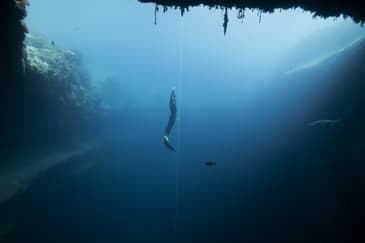
Humans have evolved over millions of years to have one overriding goal of staying alive, and the idea of holding one's breath for extremely long periods while diving into the cold and unforgiving depths of the ocean flies directly in the face of that instinct. Somehow Will Trubridge does exactly that. Will is an elite freediver with 18 world records and 6 world championships to his name and he travels the world pushing himself physically and mentally to go deeper. We sit down with Will to talk about what it takes to dive to over 100 meters and the limitations of the human body. Take a listen!
[00:00:09] Welcome back to Around the Buoy, broadcasting for the East Passage Boatwright Studios. I'm Carter Richardson and I'm here with Tyler Fields of Tyler Fields Photography. Tyler, how are you doing? I am doing great man. How are you? I'm good. Frequent listeners to this, I dare say we have a listening audience, but the frequent listeners to this podcast will always know that we've always,
[00:00:34] we spend about 11 months bitching and moaning and waiting for spring to happen and like the spring rush to happen. And then we talk about it for a month that I get when it's there and then we'll get back and we'll talk about it for another 11 months getting ready for the next spring. But every spring is different. I mean, this has been an awful winter. I mean, snow, I busted my knee awfully and it's just been awful.
[00:00:58] But this spring, I don't know if it's the early Memorial Day, but this spring has been yet again awful. I mean, I guess for you possibly, I'm like, I really enjoy bad weather. So like the blizzard, I don't have to listen to anybody talk about the blizzard of 78 anymore because I've lived through a worse one. And that was great. I loved it being snowed into the house. It was great.
[00:01:26] I just feel like this spring has been like ideal weather for like weeks. Normally we get like one week of like warm temperature, no humidity, and then it goes into like sweltering. But it's been like a month of like 70, 80 degrees, no humidity. It's been beautiful. You're smoking crack, Tyler. Are we living in like the same neighborhood? Because it's been awful. They don't allow people like me in your neighborhood, Carter.
[00:01:57] That's true. That's very true. Yeah. We all of a sudden, we went from, we had soccer. My son was in a soccer tournament last weekend. And my wife had those matches and she went to them. And it was raining and it was 47 degrees and it was windy and it was May 30th, I think. So don't tell me. I'm not saying there hasn't been bad days. I'm just saying the majority of them have been great.
[00:02:27] Like it's, my daughter and I have already gone to the beach and gone swimming. We've camped out in the yard in our tent a couple times. Like we've, we've been really enjoying the, uh, the time outdoors and it's been great. And partially, I think because this winter was so awfully long. So brutal. It was so brutal. Other than the, this couple of snowstorms we got, the rest of it did drag on and you know, the world in general is a little difficult right now.
[00:02:57] So, um, I think, I think it might be that I'm just appreciating some of the little things a little bit more than right now. Um, but the weather has been certainly one of them. I've already got my first sunburn of the year. I did have the opportunity to go out. I was delivering, uh, hall number two of these passage 24. I was delivering that to the owners and that was my first time. This was like a week and a half ago, two weeks ago. And it was the first time that had on the water.
[00:03:25] And I was like, Oh yeah, it's back baby. It's back. I love that. I haven't been out on the water yet, but I did go and shoot the first regatta of my season. Um, but I got it. Okay. Here's the thing. That was a, like a rousing success, right? Well, I mean the regatta shall remain nameless, um, because no one knew about it. And then I just, I think that we can, we can use our, our soapbox here to help those
[00:03:55] that, you know, help us. And I got to say, uh, bird's eye view helicopters, new Newport helicopter tours. I went up with them to shoot this race, uh, last week and they are fantastic. The pilot was great. The whole experience was like from, from the moment you walk in the office, they make you feel right at home. Um, the crew was great. The ground crew was great. The office was awesome. The pilot was excellent. And they, you know, they've been doing this long enough. They've shot with all the big guys before.
[00:04:24] Um, so a small fry like me is, is no big deal, but you know, they, it's like having a, being on the water, your, your photos rely so heavily on the knowledge of your chase boat driver. If they don't know what they're doing and they've got you positioned in a poor place or whatever, it can either be a constant, you like, I need to be here. I need to be there. I need to be there. Or you can have somebody that just understands sailing and can, you know, foresee where boats
[00:04:52] are going to be, where, you know, where crossings are going to happen. And this guy knew what he was doing and put us in the right spot all the time. Um, very rarely had to say, Hey, can we, you know, shuffle right, shuffle left. Um, it was, it was great. It was beautiful weather from the air. The race was pretty, pretty light conditions, um, in a pretty small fleet. But for me, it was awesome. Um, do they take the doors off of the helo when you're doing that? Are you shooting through the windows on the, on the, uh, on the doors?
[00:05:21] You, you request the doors to come off. Um, so Brian Sager and I split the helicopter this trip. And so we were on the left side and both the left doors were off. The pilot side had the doors on it. Um, so you can kind of lean out and, and there's just, there's very few things more enjoyable than cruising over Newport, over the bay, over the harbor at like 200 feet and 400 feet and just hanging out.
[00:05:51] It's, it's a good time. It's a really good time. I highly recommend it. Are you tethered? You're tethered in, right? You've got a harness on. Yeah. They got seatbelts in the helicopter and then, you know, all my camera gears tethered to me. I got, um, lanyard and straps and everything. Um, but they do, they do more than, you know, carry around photographers. They do just normal sightseeing trips in Newport. You can do private charters to get you out to Nantucket or the vineyard or whatever.
[00:06:19] Um, they, they'll do about anything you ask them to do. Um, and they were very economical for what it is and, uh, um, just super, super fun people to be around. But that's the little red helicopter you see over, over Newport all summer long, just doing, you know, 15 minutes. Yeah. We had, we were lucky enough to get, we were gifted. Uh, so my, my son and my daughter and myself went up for a, you know, out over Newport Harbor
[00:06:48] down ocean and drive and back through. And it was like 20 minutes and it was frigging cool. It was really cool. Yeah. And the pictures from that angle, the pictures are so much better. There's so much better than, I mean, you, you take really nice pictures on the water, but the pictures in the air are just because I guess you're just envisioning you hanging out of the wind, out of the door of a helicopter. That's really, they're really cool.
[00:07:14] It's the, the, I, I, I don't even know if I would have even gone out to shoot this race on the water just because the conditions were so light and, you know, middle of the day colors are terrible. And it just, the fleet was small. So there wasn't a lot going for it for me. Um, but going up in the, in the helicopter, the colors are so much richer shooting down and the angles are a little bit different. So there's a little bit more drama in what you're looking at than if you were, you know, eye level to them.
[00:07:44] And, you know, they're not really healed that much and the colors are all washed out, but from the air, the heel doesn't necessarily, is it not necessarily required for, you know, an intriguing photo. So, and so I got some of the 12 meters that I've shot a thousand times, the images that I've, I've never been able to get before and they turned out awesome. I really like them. Spartan is out. So I got a couple of really good ones of Spartan. Um, and then a couple other random boats is very cool. Yeah, it's really cool.
[00:08:13] It was really, it was really neat to say. So, um, yeah, so your summer is off. You're going to be chasing the fleet for the rest of the summer. We've got about, let's see, we've got a boat going in tomorrow and we've got like four more to go and then we're, we're done. So by the, I'd say by another two weeks, we're going to go from like pulling our hair out to totally quiet. So it's, it'll be summer then. It always is. Sorry.
[00:08:40] I didn't mean to, I didn't mean to make a pulling your hair out joke, Tyler. I apologize. That was rude. That's a little, little rude. Little rude. My daughter, my daughter was brushing my hair the other day. And she said, don't worry, dad. There's a little there. Thanks. She's very, she's very kind. Um, so I believe in the last time we recorded Tyler, I said something about what, about our
[00:09:07] next episode and I was like, oh, it's going to be a couple of weeks late and it'll, but it'll come out. And I, we are like soothsayers, my friend. It's been a little while, but the, again, life happens and, and we're a little late on this episode, but I think it's going to be a really cool one. Uh, there is some stuff, some news to catch up off in the last month or so since we've been off. Um, we are diving back into the cold war. And I think for you and I, Tyler, this is something that, I mean, we never want to see
[00:09:37] countries go to war. We never want to see that stuff. But if we could go back and relive, if I could go back and relive a lot of the, the eighties cold war espionage stuff, man, I, I, though that's so fascinating to me. So we got a little story. We got a story about some, um, some espionage, some centrifuge, some sabotage that we're going to talk about. And also, uh, that's what you think it means. Centrifuge.
[00:10:07] Centrifuge. I know what you're trying to say, but I don't think that's the right word. What am I trying to say? What's it? Intrigue? No, it's not intrigue. It's, it's center something. It's center something. Anyways. Scenality, maybe? Yeah. Scenality. That's the one. Yeah. That's the one. And then the other story we're going to cover, um, is a former guest of ours, um, was trying for a record, uh, record breaking transit Atlantic sale.
[00:10:36] And, uh, we'll catch up on, catch up with him and, uh, talk about him, uh, or talk about his, his exploits and that, but before we get to that, we do have a pretty phenomenal guest today. We're going to be talking to William Trubridge. Um, he is a world champion free diver. Um, he is gone down to depths that make me absolutely just makes my heart.
[00:11:01] And my, my blood boil because it is just, it seems to be so scary, but this guy, like it's a Tuesday for him, man. It literally, it literally was, it was just another day for him. It was just another day. Yeah. He did something before we talked to him that morning that whatever 99.99999 forever people on this planet are never going to do. And it was like, walk into the mailbox.
[00:11:34] Yeah. Yeah. So we're going to be talking to, uh, William Truebridge after this, uh, after this break, uh, it is a fascinating conversation. It's called a teaser business card. That is a teaser. That's a very good teaser.
[00:12:01] Our brains and nervous systems have evolved over millions of years to have one overriding goal of keeping us alive. And the idea of holding one's breath for extremely long periods of time while diving into the cold and unforgiving depth of the ocean flies directly into the face of that instinct. But somehow Will Trubridge does exactly that. Will is an elite free diver with 18 world records and six world championships to his name. And he travels the world, pushing himself physically and mentally to go deeper and expand the realm of what is humanly possible.
[00:12:30] Will, welcome to Around the Buoy and thanks for coming on the show. Thanks, Ketan. Good to be here. Yeah, good. So, um, even before we get into like the, your ocean depths, um, you've had a life adventure on the surface growing up on your family's boat. What were your early years, um, like on the water? Yeah, as kids, uh, my earliest memories were of living on the boat, um, sailing first across
[00:12:55] the Atlantic through the Caribbean and then kind of connecting the dots of all the islands in the South Pacific to, to arrive in New Zealand. And we arrived when I was five. So I can remember some of the Pacific and a little bit of the Caribbean, but not much before that. Um, and the, this, the sea living on the boats back then, it was everything for us.
[00:13:19] It was obviously our means of transport, but also, uh, like a playground, uh, school, uh, grocery store. We'd get fish and lobster and everything we needed from it. So it was like a life, um, completely lived on the, on the ocean. And I think that's kind of where the love for the water and the passion for freediving was instilled in me. Yeah. When you, when you grow up on the water, especially living on a boat, I mean, we'll get
[00:13:48] into this, into the interview, but being comfortable on the water is imagined is the, the biggest thing around you. And when you're surrounded by it from an age of as when you were born, I'm sure you got very comfortable very quickly with water. Definitely. And I think that's probably the key factor that has helped me in my freediving because physiologically I've had all the tests done and I don't have like abnormally sized lungs or anything else
[00:14:15] that's kind of playing in my advantage physically, but just that comfort in the water and being completely relaxed, whether it's on the surface or at depth, I think is a, is a really important component to this sport at least. Yeah. Was the plan to stop in New Zealand or is that just kind of where the, where the party stopped? Yeah. Well, my parents were actually kind of loosely targeting Australia, New Zealand, but then
[00:14:42] when we were in Tahiti, uh, we went to school there for a year and they fell in love with Tahiti and actually wanted to come back and become residents there. But then, uh, it's not a very easy place to do that. So we went first to New Zealand in order to kind of work and, and apply for the residency in Tahiti and then, um, kind of fell in love with New Zealand and got stuck there instead. Sounds like a nice place to be stuck.
[00:15:12] Yeah. Yeah. So it was in your early twenties that, that free diving and diving became something a little bit more. And you mentioned that, you know, that's kind of your passion for that developed living and sailing on the boat. But what was it in your twenties that really led you down this path? Yeah, it's a good question. And at that time, if I cast my mind back to how I was, like I'd just come out of uni,
[00:15:37] I was, um, I worked for a year in the career that I had chosen, which was genetics. Um, but being in a lab all day, stuck kind of working with stuff that you can't see doing experiments and stuff. It wasn't my cup of tea. So I went traveling and worked for a year in London at a hotel. And while, and while I was there, I heard about free diving, um, and kind of pripped up my ears and decided that I wanted to give that a go.
[00:16:05] So I traveled to the Caribbean to, to try it and fell in love immediately. And I think for me, it wasn't just that kind of return to the oceans and to the water, but also I'd kind of had this, um, need to be engaged or challenged both on a physical and a mental level.
[00:16:29] And so when I was working in the lab, it was like a mental career, obviously, but that physical energy wasn't being, being used the same. I used to play chess as a kid and tournaments and I did well, and I'd maybe won the trophy, but I'd come home and I'd like vomit everywhere. Cause I'd have all this kind of nervousness inside that, that wasn't coming out. And so then at university, I rode, uh, on a team and that was a beautiful sport.
[00:16:55] You're on the water, you're gliding across the surface, uh, in the early morning with the mist on the water. It's an amazing experience, but at the same time, it was just physical. There wasn't really much of a mental component. And so when I found free diving, which combines that mental and physical to the nth degree, then it really was like this holistic challenge that kept me completely satiated on both levels. How do you find like to get that, that entry into the sport?
[00:17:24] I mean, clearly you've, you have to be taught how to do all this stuff and the things to worry about. Did you fall under someone's apprenticeship or how, how do you, how do you get into it? Yeah. Yeah. Very early on, I was just doing it myself off the back of scuba boats in Honduras, um, wrote then Utila in Honduras. And I'm very lucky to have come through that period, to be honest with you. The garden rule of free diving is that you do not ever, ever do it by yourself.
[00:17:52] And I was literally diving, free diving by myself. Then, then I fell under the wing of, uh, an Italian who was at the time kind of the top in the sport, Umberto Pellazzari. I took his course and I kind of stuck around, hung around him long enough until he was like, okay, put me to good use. And I started to translate some of the texts from Italian to, to English and help teaching some of the courses.
[00:18:19] And through that relationship, it gave me kind of like, um, um, a foot up, which helped me to, to establish myself, I guess. And, and also a lot of the philosophy or the approach that I have in free diving comes from him. And he in turn inherited it from his teacher was Jacques Mayol, who was the subject of the Big Blue movie.
[00:18:43] Uh, so he was the first one to kind of employ yogic techniques and deep relaxation and breathing and free diving. And so I kind of feel like he's my, I never met Jacques, but I kind of feel like he's my grandfather in the sport. And Umberto helped me at the start as a kind of like a maestro, um, to, to begin the career. Cool. Uh, let's, let's get into the sport. So most of our listeners, um, will are completely unfamiliar with the sport of free diving.
[00:19:11] And to be honest, Tyler and I don't know much about it outside of watching just incredible feats of, uh, of physical and mental, uh, abilities, but give us a quick overview of the sport and then let's talk about what you specifically focus on. Sure. So free diving, there's pool free diving and depth free diving. Uh, typically I focus on the depth disciplines and there are four of those.
[00:19:36] There's with fins, in which case you can dive with a monofin, which is like a big mermaid tail or bifins, your conventional flippers, but they're carbon fiber long and pretty state of the art. So those are two disciplines. Then there's also rope pulling where you pull yourself down the rope. It's weighted at the end and pull yourself back to the surface. But the fourth discipline is what I see as the purest form of free diving. And it's the one that I've focused on throughout my career. And that's the unassisted discipline.
[00:20:05] It's basically just your body and the water. How deep can you go using what you're born with? And so we swim in that discipline, kind of an adapted form of breaststroke, underwater breaststroke, um, using like big movements of the, of the hands, breaststroke kicks. And in that discipline, uh, now the, the, the depths have exceeded a hundred meters.
[00:20:33] And so that is the constant weight, no fin, right? CNF. Yeah. And then the other one you were talking about was free immersion, right? Is where you can use the rope to assist you down. Yeah. The, the naming is kind of a little bit awkward. Um, so constant weight refers to the fact that whatever weight you take down, you have to bring back to the surface because there used to be, they're not really practice anymore.
[00:20:58] There used to be disciplines where you had variable weight and you could ride like a sled or a weight down, leave it at the bottom and then come up either pulling on the rope or with a, like a lift bag, like a balloon. But that's less of an athletic discipline. And so it's been kind of left by the wayside a little bit. And now we focus on these four athletic disciplines, which are all constant weight, whatever weight you bring down, you've got to take back up with you.
[00:21:25] And it just changes the modality of how you are propelling yourself, whether that's with bifins, a monofin, pulling on the rope or with nothing at all, just your hands and feet. And that the sled is almost more like a, like a rollercoaster ride. It's a great video, but it's just, you, you're pulled down and pulled back up, right? It's not really. Exactly. Yeah. And it gives a bigger number and sometimes people kind of are more awed by that number.
[00:21:56] But essentially what you're doing is just dunking a teabag. Like you're not actually contributing to the movement. You're just holding onto the sled and getting dunked down and back up. And it becomes more like a technical exercise. And also there's, there's complications with gases becoming narcotic or toxic and yeah, all kinds of jazz. So it's, it's for those reasons, it's no longer competed. Like it's not part of competitions.
[00:22:25] You can, I think still do a standalone record attempt, but most modern freedivers aren't really interested in that. So you're saying you sit on the surface and you dive down and as you said, you breaststroke down and then you just, you go down without touching the line to as far as you can go and then zip back up again, not, you're not assisting by, by anything. Correct. You can touch the line once when you turn around at the bottom. Okay.
[00:22:52] We have to like grab this tag that's on the target depth. You announced the night before, okay, I'm going to try 90 meters. And then the plate at the end of the line is set at 90 meters. And on that plate, there are these Velcro tags. And our job is to swim down, take one of these tags, attach it to a wetsuit and then swim up. And when you do that turn at the bottom, you're allowed to grab the rope so that you can grab
[00:23:20] this tag and you're allowed to pull it once just to start your ascent. The, the videos are, are incredible. And it's for somebody who has, has scuba in the past and spends a lot of time in a pool, but watching you five or six strokes, and then it's just negative buoyancy of your body pulling you down to, to your target depth. That is such an amazing thing.
[00:23:49] And just the most graceful movement to watch. Can you kind of explain to us, and I'm sure this is a topic that we could spend decades studying, but kind of the body's response to diving to these depths and how you deal with that? Yeah. It's a fascinating part of, of the science of the sport because there are physiological responses, reflexes that happen in free diving, which do not take place in literally any other sport.
[00:24:17] And there's a lot of them. Like we're just every year we're finding out more about what is changing in the body during a deep free dive. So to run through a few of those, the main one is one, is something that we call the dive reflex, which is an adaptive reflex that helps your body to conserve oxygen during the dive. And we share this reflex with all mammals. It's called the mammalian dive reflex, but the mammals that happen in spades are the,
[00:24:44] obviously the aquatic mammals like the dolphins, but more so than the whales and the seals. Some of which go to beyond like a kilometer or more than a mile of depth. And in order to do so, they have to be able to shut down their metabolism, shut down their blood flow to the extremities so that their muscles are no longer using oxygen or they're using their kind of inbuilt myoglobin supply of oxygen.
[00:25:10] And all this conserves the oxygen for the heart and the brain, which are the only muscles that cannot cope without oxygen. And so we have like a very mild version of that reflex, but it's strong enough to allow us to adapt and to go a lot further than we should be able to on the one lung flow there that we have.
[00:25:34] So for instance, I was training this morning and according to my Garmin, my heart rate dropped to 30 beats a minute on the way down to maximum depth. And it drops very quickly. So I'll be swimming down actively. And as soon as I go into that free fall that you mentioned, which is where the body is now negatively buoyant enough because your lungs compress, right? So you lose the buoyancy that you have on the surface.
[00:26:00] So now I can stop swimming and just tuck myself into like a narrow hydrodynamic position and free fall. And because I'm not swimming, because my body's being crushed by the pressure, because I'm holding my breath and CO2 levels are coming up and the oxygen is going down, all of these trigger this reflex. And my heart rate drops from, at that time, it would be maybe like 70, 80 beats a minute to 30 beats a minute in the space of 10 seconds. And that's a totally unconscious thought.
[00:26:31] Like that happens. You don't have to train to do that. That's going to happen regardless. It's reflexive. Yeah. It's not controlled kind of by your voluntary nervous system. And so my resting heart rate when I'm asleep, the lowest I've ever seen it is like around 45, 43, maybe at the most. So it's going significantly lower than that. At the same time, metabolism is pretty much subordinated completely.
[00:27:02] The spleen, which is this like spongy organ in the back of a torso, which stores red blood cells, that contracts. So it squeezes a sponge and releases those red blood cells into circulation. So we get this bonus of extra red blood cells, which are the ones that carry your oxygen. So you get like fresh oxygen into the supply. And I can go on. There's something called the Bohr effect where we gain better access to hemoglobin.
[00:27:33] There's bradycardia, obviously, of the heart. But the lungs, the capillaries of the lungs distend. They swell up with the blood in order to compensate for the loss of volume, of air volume in the lungs. So that helps protect the lungs. It's all these amazing reflexes that happen that we're studying that are pretty much unique to the sport.
[00:27:58] And then the more you do this and the more you learn, the more you're able to maximize what your body's reaction is for increased performance or further depth. What is it for you that is the limiting force? Is it the depth itself with the pressure of increased atmospheres? Or is it the oxygen limitation, the CO2?
[00:28:27] What is your floor? Right. Yeah. So for me, it's always oxygen. It's hypoxia, low oxygen at the end of the ascent. So when I'm coming to the end of the dive, if I've pushed it too long, too deep, then I might run out of oxygen as I'm surfacing or just below the surface. So that's my Achilles heel. And for most of the top freedivers, that's normally the case.
[00:28:55] We get to a point where we can adapt, like our body is able to accommodate pretty much any pressure. We can equalize to almost any depth that we can swim to. And so the weak link then normally becomes the oxygen, just how much we can stretch that finite amount of oxygen in the body during a long freedive. In your training, so just as you said, it's oxygen.
[00:29:24] So therefore, that last breath you have, your last breath, you can get as much oxygen as possible. So that's a limiting factor. But then the other half of it is your mental preparation for this. Do you give them an equal 50-50? Like, is your mental training just as important as your physical training? And what mental load goes on in your head during the dive? Yeah, I often say that it's 100-100.
[00:29:54] I don't think you understand that's impossible, Will. Yes, yeah, it is. But there's this idea that the two are absolutely critical because you cannot meditate yourself down 200 meters and back. You do require, like, the most efficient movement and strong power-to-weight ratio in the muscles that are used for the swimming, hydronomics, everything else.
[00:30:22] So the physical side is integral. But so, too, if you just go on brute force alone, then you're going to run out of oxygen halfway up because you have to be able to overcome. And the mental side is almost in some ways more of a finesse. It's more difficult because minds, brains are plastic.
[00:30:44] And so any technique that you use in order to relax or to deal with stress or nerves, that's only going to work for a certain amount of time before your mind learns. It's like your favorite song, right? It won't be your favorite song forever. You kind of become numb to it. So these techniques that we use, we have to cycle through them and constantly reinvent them in order to stay one step ahead of that voice in your mind, which is telling you, no, you can't do this dive today.
[00:31:13] This is the last breath you're going to take. The worst possible thoughts that you can imagine are the ones that are going to pop into your head in that last breath that you take before starting a dive that takes you the length of a football field down and lasts four minutes or more. So you've been doing this for more than 20 years now or close to it? Correct, yeah. Are you still fighting that every dive? The mental side? Yeah.
[00:31:44] Yeah. Now I feel like I've reached a level where most of the time I'm in control. But if I go to a competition or a record attempt, then you're straight back in there dealing with this same kind of stuff. You're confronted with everything that your mind is going to try and do to kind of put a stick in the spokes kind of thing. Yeah.
[00:32:12] It's amazing how resourceful that kind of negative voice in your head can become at those times. And so trying to combat it just adds fuel to the fire. You have to develop techniques that allow you to detach yourself entirely from your own thoughts as well as everything that's happening around you. You did a really incredible TED Talk.
[00:32:38] And just in your telling of a dive, which, again, you wrote a book. I believe it's called Oxygen. That after watching that TED Talk, it's made me really excited about reading this book. But even in the video that I watched, I started to feel the stress of the dive as you walked through and as you explained it.
[00:33:03] And, you know, you can talk about your body's automatic reaction to going to a depth. But for those that don't do it, my automatic reaction would not be letting my heart rest at 30 beats per minute. My heart rate would skyrocket. I mean, it would just peak and then all of the oxygen would be gone. So the mental aspect has got to be just an incredible journey to go through as you get better and better.
[00:33:32] Definitely, yeah. It's, as I said, it's always a work in progress because the mind is always evolving. But it's a challenge.
[00:33:43] And it's another part that makes the sport so much more fulfilling because it really is like this holistic enterprise that is, you're kind of taking yourself into, I equate it to like this liminal zone. Like if you go deep enough, you cannot survive underwater at that depth.
[00:34:08] And so you're daring yourself to stretch out this kind of umbilical cord that you have to the surface as far as you possibly can on the way down. And then on the way back up, you have to kind of prove to yourself that you are capable of getting back, of making up that distance that you've stretched this umbilical cord.
[00:34:36] And in a way, it's like, I love to read stories of alpinism because in a way, it's a similar kind of a zone, like the death zone that they talk about in 8,000 meters, whatever it is. You're going into this area where the body cannot survive that long.
[00:34:56] And you are testing yourself about how well you can perform in that zone, how far that you can kind of venture into this underworld, into this Hades, um, in order to try and bring back some kind of extra, not just the depth of the world record, but just like an extra understanding about who you are and what you're made of.
[00:35:22] You mentioned a couple times this is a competitive sport, and so there's competitions. How long have people been competitively freediving? In the sense that we're competing now? Yeah. More or less like 20, 30 years. Okay. So it's still a relatively new sport then. Yeah.
[00:35:44] Before then, like if you go back to the 50s, 60s, there was, were competitions in those disciplines where they went down with a sled, but it was more just kind of like one-on-one stuff. There wasn't like big events. And there was a lot more, because it was these kind of like spectacle events, maybe there was more media involvement for those particular dives.
[00:36:10] But again, it wasn't so much a sport as like a stunt or a spectacle. Yeah. So yeah, the sport itself that we are practicing now is about maybe 30 years old. I'm interested in what we're going to talk about your, like the current best, like the world record that you've set. What is that now? And what did that look like five years ago or 10 years ago? Has it been kind of a smooth ascent or descent to deeper depths?
[00:36:40] Or has it been like jumping and plateauing and then jumping up again and plateauing? A little bit, but it's plateaued now in recent years. I feel like we've gotten close to whatever. There is no like set human potential, but we are getting close to that asymptote, right? Yeah. And whereas when I got into the sport, when I first got into it 20 plus years ago, at that time, the world record was 60 meters in the no fins discipline, unassisted.
[00:37:10] And to me, that was just mind blowing. Like I could not kind of get my head around how someone could. I remember watching that video on repeat, just like studying this guy's technique and being amazed by how it was possible someone could swim down like that. And I set myself like that as a target. That was my passion. That was what I was kind of driven by.
[00:37:35] And I kind of set myself this exorbitant goal of getting to, what was it? Yeah. 250 feet by my 25th birthday. This is when I was maybe 22 or 23 years old, which is like 76 meters. And at that time, the record was 62 or 63. I didn't tell anyone because they were just being laughed at. But it was like my like secret, like, again, this is what I'm going to do.
[00:38:04] I'm going to devote myself to the sport and get to that depth. And then like a year or two later, this Czech diver, Martin Stepanek, dived to 80 meters, which is 270 something feet. So it kind of blew that record out of the water. And everyone at that point figured, OK, that's that. That discipline's gone and no one's ever going to break that record. 80 meters is crazy.
[00:38:30] The record with fins at that time was still only like maybe 93 or 96, I think, or maybe they'd just gone to 100. So no one was thinking about breaking that. But I looked at the video and I was like, I don't know. He's obviously an incredible freediver strong, but his technique in this video is not great.
[00:38:54] Like if someone with the same training and skills did the same dive with better technique, they would go deeper. And so I set myself a new target of 300 feet by my 30th birthday. And then and eventually did get to that depth, which then was, of course, a world record. But before then, I broke his record with 81, 82, 84, 86, 300 feet is, I think, 92.
[00:39:21] And I did that in 2009. And when I got to that depth and I still wasn't at my limit, it kind of opened this idea of, well, maybe 100 meters is possible. Before then, I hadn't even kind of thought, dreamt about that as a potential depth or goal. But I started thinking about that and training even more.
[00:39:47] And eventually, a couple of years later, set the record with the first 100 meter dive. And since then, I've taken it to 102. But to get from 100, 101, 102, those extra meters for me were kind of like almost as difficult as getting to 100 in the first place.
[00:40:09] Like just because I'm getting so close to whatever my potential is that I had to train for 16, 20 months just at one more meter kind of thing. Well, and this is the reason why I was going that way was, I mean, look back in the history of sport. It wasn't until the 50s. We've been running forever. And it wasn't until the 50s that we broke the four-minute mile. We used to think our heart would explode. And now you've got high schoolers that are beating the four-minute mile.
[00:40:39] And then there were two marathoners last, a couple weekends ago at the London Marathon that did sub-two-hour marathons. And again, Kipchoge, I think, when he tried to break the two, like he had a windshield. And he was going, doing all these things. And now we're breaking it. And the guy that won the two, the sub-two-hour marathon was like, yeah, I could easily go further. And so we're like, what's your four-minute mile? What's this sport's four-minute mile?
[00:41:07] Now, you said you think you've kind of reached it asymptotically. But is there some young up-and-coming Will Trubridge who's 20 years old right now watching your videos and is like, hey, his technique's kind of crap. And I'll be able to get down to 120 meters no problem. Is that, I mean, is it theoretical that that's going to happen? The record will definitely be broken. Yeah, of course. Definitely go deeper. 120 meters, I would be incredibly surprised.
[00:41:35] Like we can say, for instance, categorically that 150 never will happen with no fins in this discipline. Whereas 103 is, of course, possible. So one is, it's just this kind of like increasingly more gray area where somewhere in there there's a limit. We will never be able to put our finger on that limit.
[00:42:01] But our job is just to kind of take that depth, that potential, human potential underwater as deep as we can, as far into that gray area as possible. You know, you talked about the next generation of divers. And along with your own training, you also teach free diving clinics and workshops. Who are the people that are signing up for this? Are they just adventurous people?
[00:42:28] Are they future pros that are looking for that edge? It's like you watched that video over and over and you picked out the things and the technique that you could do better. Is that who is taking these courses? It's a mix, yeah. There are people who are serious about the sport and want to do everything they can in order to advance themselves. There are others who are recreational.
[00:42:51] People maybe who just want to become better spearfishers or be more comfortable in the water or be able to like snorkel better on the reef. And so the people who take our courses, our free diving courses from all kind of different areas. But we also run courses where we use free diving techniques as a vehicle in order to expand people's idea of their own potential.
[00:43:17] And this is a business that I've recently co-founded called The Rebellion, The Rebellion Impact Group. And we're using it mostly to begin with, with like CEO groups, peer groups and entrepreneurs and a little bit with sports teams at universities.
[00:43:37] And so we can teach them the same techniques that I've used in my record attempts, the breathing and the mental techniques that I've used in order to activate the parasympathetic nervous system. And the kind of calmness under pressure that we need in order to be able to perform in many, not just in sports, but in the boardroom and negotiations and in our family life as well.
[00:44:04] And the kind of altercations that we have at home, at work and all these scenarios, we can benefit from being more calm and composed under pressure. And so free diving has kind of been like a trial by, what do we call it, like a trial by fire for me to create these techniques.
[00:44:25] Because literally my life depended on me being able to relax in that extreme kind of like test tube version of extreme pressure and stress. Taking a breath that you know has to sustain you for four minutes and a dive to 100 meters and back and having that thought in your mind, pop into your mind, like this is the last breath that I'm going to take. Like how do you deal with that mentally and the stress that it provokes?
[00:44:52] And so being forced to confront that in myself has led me to create these techniques and also the breathing techniques that help to pacify the nervous system. And we've seen such incredible application for all of those techniques in people who have to deal with pressure in their day-to-day lives, which let's face it, it's pretty much all of us these days. If it's not at work, it's at home or both normally. So I think everyone can benefit from these techniques.
[00:45:22] They're so powerful. And critically, they don't come with any contraindications. So we're living in an age where like so many people are becoming dependent on benzodiazepines and other drugs in order to cope with anxiety and stress. But we have these built-in mechanisms that don't create any of the kind of downstream consequences of those drugs. And they are so powerful and immediate.
[00:45:48] And you can use them and program them into your subconscious so that just like my dive reflex, it's outsourced and it's automatic. And so in these situations, you'll find your nervous system is just triggered into a kind of calm, composed state. And that's, for me at least, that's huge in these situations.
[00:46:11] One of the interesting sidebars of your story is the locations that you get to go to visit and to dive. And the one that is truly remarkable is Dean's Blue Hole in the Bahamas. And I'm assuming that's where you are right now? Right now I'm at home, but this morning I was in Dean's Blue Hole. Talk to us about that place and what makes it so special for what you were doing, especially in general, but for what you're doing. Why is it so special?
[00:46:41] Oh my gosh, yeah. I could wax on it for days about this. I mean, you could not, I could not sit down with pen and paper right now and design a better location for freediving. It is a 200 meter deep, which is more than we're ever going to need, 200 meter deep sinkhole in the corner of a perfect lagoon with a white sand beach that encircles it.
[00:47:05] And so it's completely enclosed and sheltered from all the wind, which is a huge deal in freediving because any waves on the surface is going to make it difficult for us to breathe up. Any current at depth, which is pretty much anywhere in the ocean, open ocean, that current is going to mean that you're going to have to work harder to swim vertically down and up.
[00:47:32] Then jellyfish using boats or the rest of the hassle, like not to mention like most of the ocean is pretty cold. So Dean's Blue Hole is like a, basically a 200 meter deep swimming pool that's in the corner of a lagoon. And not only that, but this morning we had two little baby turtles who have been there for like a couple of months now and they've become really accustomed to us.
[00:47:57] And they'll swim right up to us as we are preparing to dive and sometimes even follow us down for a bit. There's a school of tarpon underneath the, the kind of the eaves, the overhang of the Blue Hole. Barracudas, big coubera snapper, all kinds of reef fish. So it's incredible. It feels like diving in like an underwater cathedral. That's really special. The photographs are beautiful, just incredibly beautiful.
[00:48:27] There's a couple other, there's, so you mentioned it was 200 meters deep. There's a couple other ones that are a little or a lot deeper, I guess. There's one in the Yucatan somewhere and then one in the South China Sea as well. Dragon's Hole, I think. Great. Yeah. So these two, I mean, technically, I guess by some definition they are deeper blue holes, but the one in, in China, it goes down on an angle.
[00:48:54] So if you were to hang a rope down, I don't know that you could hang one vertically for 200 meters. We'd have to be like in exactly the right spot. It's not somewhere where you could free dive, even if they allowed you to, which the Chinese don't because it's part of one of their military islands. So forget about that one. The one in Yucatan is like, it's, it's kind of close in shallow water, close to the shore where it's always green. And so the whole, I haven't been to it myself.
[00:49:25] There's the Great Belize Hole, which is a bit of offshore. It's not as deep. I think it's maybe 80, 90 meters. But the one that's been discovered recently, that's now the deepest, is in kind of very shallow water. So it's this kind of green brackish water. And I don't think it would be a very pleasant place to free dive because below probably about 30, 40 meters, it would be pitch dark and kind of murky water.
[00:49:51] So technically, yes, that's the deepest one, but hard to get to, very dark and green and pretty foreboding. So when you're, when you're down at 100 meters, like, let's say in Dean's Blue Hole, and you're down at 100 meters, are your eyes open? Like, is it, is it bright? Is it still blue or at that depth? It's blue. It's not bright. Depending on what the visibility is, we might see the line clearly or not at all.
[00:50:18] If the wind is strong, then it whips up the waves in the reef and that stirs the water. Visibility drops and below 60, 70 meters, it's dark. But today it was, it was beautiful. It was gin clear water. We could see probably 30, 40 meters down. And I did a dive to 90 meters and I could see the rope clearly in front of me. That's so cool. That's so cool.
[00:50:43] In other interviews I've watched and read of yours, you tend to keep future goals to yourself. And I would expect nothing else for this interview, but we do have to ask the question, what's next for you? Yeah, I do have projects that I'm working on goals.
[00:51:00] Like you said, I feel it's better to keep those interior, not out of any kind of like selfish reason, just because at least for me, that works better. It's like a furnace, right? If you keep it closed, then the heat builds inside more and then you can use that heat to reshape metal.
[00:51:28] Whereas if you, on the other hand, kind of disperse, if I tell everyone, okay, I want to be at the Olympics in 2020, where is it? Eight in London? In LA. Yeah. Yeah. If you tell everyone that, then you're only going to get positive feedback from it. People are going to be like, oh yeah, no, you can do it. You're going to win the gold medal. You're so good. And that feedback actually, which is the hormone? I think, is it dopamine or serotonin? One of the two.
[00:51:58] Probably dopamine hit, which takes away some of your motivation in order to achieve that goal. Whereas if you don't tell anyone, then the only way that you can actually get that reward is through achieving the goal itself.
[00:52:15] And so that's been my kind of MO is to, right from the very start, to begin with, it was because people would have laughed at me if I took the dive 300 feet when the record was 260 and I was in no one.
[00:52:32] But now I've seen that it enables me to kind of build that furnace of motivation inside without it dissipating by spreading it far and wide. So at least for me, that seems to work. Are you any closer to your expedition to Jupiter's moons? That doesn't rely entirely on me.
[00:52:59] I'm still waiting for Elon to build my spaceship to get there. But I mean, that would be amazing, like to dive in a completely different planet. I'm sure our physiology probably wouldn't be up for it. We'd probably get some kind of like advanced form of gas toxicity or DCS, like deconcussion sickness. But the idea of it, at least, it would make a good sci-fi movie. We have a broad base of listenership.
[00:53:27] We cover a lot of topics on this show. It's not out of the question that Elon listens to us, but it's a long shot. It's a really long shot. It's a really long shot. Well, if you are, Elon, then sign me up. Yeah. How do people then follow what you are doing? When you achieve these goals, how do we follow what you're doing? I'm kind of a little bit slack with social media, but Instagram is probably the main one that I update. That updates automatically to Facebook as well.
[00:53:57] I have a website, which is williamtrubridge.com. And then also the techniques that I've talked about with regards to coping better with pressure and stress and anxiety, that's all part of the mental immune system. So there's a website, mentalimmunesystem.com, that covers that side. And then the Rebellion Impact Group. I think it's rebellionimpactgroup.com is a business where we are taking these techniques to larger groups,
[00:54:26] especially peer groups of CEOs, entrepreneurs, executive leadership teams. And so we run retreats and on-site experiences where we take people through these techniques. Very cool. Cool. Well, we cannot thank you enough for the time to sit down and talk about this. This is absolutely fascinating. Best of luck in your future dives. And thanks again for coming on the show. Thanks, Carter. Cheers, Tyler. Great to talk to you guys.
[00:55:16] Welcome back to Around the Buoy. So to get a reference of what the depth that this guy is diving, well, I could probably say the reflecting pool in the National Monument. We all know what the length of the reflecting pool is. How many Pringles canned deep did he dive? Let's make this as American as possible. 250, baby.
[00:55:47] But to the concept of diving to over 300 feet. And again, just like you said before the episode or before we had the interview, Tyler, it was a Tuesday for him and he was at the blue hole diving down. And he was like, yeah, I got to like 90 meters, whatever. It was no big deal for him. So it was a Tuesday. To put it as simply as possible, right? You say it's a football field. Think about a football field.
[00:56:15] You dive from one end of the football field to the other. That kind of gives you an idea of the distance. But unless you have been underwater further than like a swimming pool, your mind, you can't comprehend what that actually means. Like 30 feet, that's deep, right?
[00:56:41] Like you're, that's when you learn how to dive, you know, 30 feet or whatever, doing enclosed water or whatever in a bay, stuff like that. And then you start to go into 60 and you start learning how it affects your body. And, you know, you can't just pop up from 60 feet. You learn all the bad things that happens to your body.
[00:57:02] And then you start thinking about exactly how far he's going down on a single breath by him, like just self-propelled. And it's just unfathomable that he's able to do this at all, let alone be able to do it as much as he has and just to feel completely normal about it. So what you, the thing you were saying about the depth of it and the pressure.
[00:57:31] So I just did a quick Google search and at 300 meters, you are at about 30 atmospheres. So that is, we're sitting here at atmosphere, you know, one atmosphere sitting at sea level. So multiply that by 30. That's so you're talking about, I think I said it was 450 pounds per square inch. So that has how much pressure is being exerted on the body at that depth.
[00:57:56] And so you think of, I mean, granted, he's, he's clearing his sinuses and clearing his nose the entire way down. He's equalizing, but the, the amount of pressure on his body at that depth. And the, what, what is incredible about it and what really blows my mind is that even at that depth, even with safety divers, there's zero room for error in just a practice dive.
[00:58:25] I mean, it's like, it's like base jumping. It's like, I don't know, do you remember when Travis Pastrana jumped out of an airplane with no parachute on Tyler? That was like late nineties. Did he jump out of one into another or was Red Bull did that? That has been done. Yeah. Right. That has been done, but he just, he, he was, they filmed him and they sent a bunch of people out and he just woke up. No, no. He, he woke up and then jumped out without a parachute.
[00:58:54] And then he, someone came at, as it was time to pull the chute, someone came, grabbed onto him and, and, and, you know, locked himself or, you know, they attached each other together and then pulled the chute. But that, that, that, that, that stunt, you can practice it on land as much as you can, but that stunt has zero room for error. And what Will does every single time he goes down to that depth is be, you know, you don't have any room for error down there.
[00:59:21] There's no, if anything goes wrong, it's all over. I mean, he does lights out real quickly. He spends a lot of time acknowledging the, the safety folks, the safety divers and stuff like that. But, um, I don't believe in listeners can certainly correct me if I'm wrong. I don't think the safety divers go down all that far. So there may be, no, they don't. And that's 60, 70 feet, a hundred feet, maybe. Um, but like they can't just go down to a hundred feet and pop back up.
[00:59:51] So they're going to have to stage divers, you know, every, whatever, 10 feet. Um, because that's not for, that's not doable. It's not. Yeah. And then, so the other free divers that go down and they all swim down 60 feet or whatever and watch divers as they come up. But when they see them start to lose it, start to go unconscious, it seems to me like they just basically hold your mouth closed, hold your nose closed and swimming to the surface.
[01:00:21] And then there's nothing they can do below, below the surface. So it's when they get you up on top that they can start doing rescue breaths and stuff. Um, yeah. Yeah. But it's, I would imagine that Travis Pastrana had more options available to him free falling than they do at depth. Because he had one option, someone wrapping his arms around him and put a chute on his back. You're right.
[01:00:51] I mean, maybe there's probably a couple of people that could have done it, but, um, there's nobody at 300 feet. Yeah. Nobody. You're alone. You're alone. The giant squid maybe, but that's about it. Yeah. I think there's just a limit to what we can, the, the big jump I don't think is available to them anymore. Like they're, they've reached the point in their body where they're not going to get a mysterious extra 10 meters. Right.
[01:01:20] He's talking about feet at a time. Um, yeah. You know, one foot, two foot changes in the record. Um, and he's talking about that being that one foot being the difference between him surviving and him not surviving. Mm-hmm. But you look at, but I, I, you, you look at Roger Bannister when he broke the four minute mile in the fifties, that was the fifties that had happened.
[01:01:46] But that people literally thought hearts wouldn't explode that, that you would just, you would lose it. And Roger Bannister went out and did it. And all of a sudden everyone thought, oh, I can do it. And now they're doing it. And as I said in the, in the interview, we're now running two people just run or ran a sub two hour marathon. So they're now running 26.2 miles at like four minutes and 20 seconds a mile. Yeah. But that's just, yeah.
[01:02:15] Granted, they have access to air the entire time. So it's, they, they're always breathing. The four minute mile, the amount of like starting with equipment, right? The running shoes much different than they were when they broke the four minute mile. Right. Yeah. Then the training, the preparation, the nutrition, like these guys, the, the marathon runner, I forget his name now. Um, his full time existence is running.
[01:02:45] He has people that sort out his food for the day, his nutrition, his supplements, his, his, I'm sure there's some sort of, uh, stretching. There's some sort of way, if it's not weightlifting, some sort of workout like, right. That he does. And it's all specific for him to go fast. Yeah.
[01:03:08] And that just wasn't like whoever this Roger fellow was like, he had a guy on the side of the track that was giving him a cigarette between laps. Like that was the peak performance at the time. Well, he literally just got, he was a medical student, uh, and at Oxford or Cambridge, one of the two. And he just finished a shift and came out and threw on some spikes on an Ashton track and ran it.
[01:03:30] And so, but what, what Will is doing is our body, the human existence is always about pushing the boundaries and we'll push the boundaries down to 103 meters. And there is some kid who's going to be listening to this podcast and is going to say, I got it. I'm doing 110. No problem. I'll get there. I am scared to death with the idea that there are children that listen to us. That is a horrific thought.
[01:03:59] Uh, all right. So, uh, thank you to Will for coming on the show. It was really a fascinating, fascinating talk. So Tyler, let's talk about, uh, our news items. Tyler, I think you're up first with the news items. So listeners to, um, around the movie will remember Andrew Bedwell from a couple of years ago. Um, I want to say 2023 at this point.
[01:04:24] And he was trying to become the world record holder for the smallest vessel to cross the Atlantic. Um, and the record was set in 1993 with a 1.62 meter boat. Um, I don't know what that is in freedom units, but let's call it, uh, I don't know. Like three and a half, three and a half feet. Uh, three. Well, no, it's like four feet. Four. Okay.
[01:04:53] Again, public school system. Wasn't my, wasn't my first day. Anyway. So 1.62 meters. Andrew was going to beat it with a vessel of 1.2 meters. And he had found this vessel that a previous man had started and he kind of retrofitted for, for his own use and set about setting this record. Um, and he's six foot something tall. So this isn't, you know, there's, there's a lot that went in to his preparation, um,
[01:05:21] um, for this attempt. So 2023, he shipped the boat from England to Newfoundland. He set out and within the first couple hours, um, the boat had some leaks that they were trying to track down. So he decided to turn around, head back to the travel lift. They hauled the boat up and during the lift, the straps failed and it dropped the boat and
[01:05:50] just trashed it, um, beyond repair. So he went from the high of setting off on his record attempt to being, um, completely destroyed within six hours, whatever it was. Um, obviously very emotional. Um, he dedicated a lot of his life to this, um, and he vowed to, to rebuild, try again.
[01:06:14] So over the last three years, he set out building a new vessel, um, of aluminum. Um, he and another yacht designer designed the boat fully themselves from the keel to the top of the mast, outfitted it, found sponsors, you know, all the navigation equipment, the radios, the E-PURBS, the dry suits, the special, the specially made. Dry suits, you know, the nutrition, everything. Three years he's been preparing for this.
[01:06:43] Um, he shipped the boat to Newfoundland here recently. And amazingly enough, either I just have not been paying attention or they just didn't do a lot of marketing for this. Um, I didn't really even know that this was happening until after, um, the BBC was even, I believe, filming a documentary on this.
[01:07:08] Um, but either way on June 4th, he set sail from Newfoundland heading East towards Falmouth, England. Um, it's about 2000 miles, 1890 nautical miles or so. Um, and I think we, when we talked to him, he was going to take 90 days or so. Um, which is, that's a, that's a trick. That's a, that's a long way to go.
[01:07:32] Um, the only reason why I found out about this, him setting off is because two days later, so that was the sixth, there was a post on his Instagram that said technical issues. Andrew is safe ashore. And then more information to follow. So, um, I just kind of jumped on, started doing a quick search and come to find out after about
[01:07:58] 75 miles, he contacted the Canadian coast guard and said, um, um, something's wrong. We don't know what it was. Um, and I needed some assistance. The coast guard went out, hauled him out of the boat and took him to shore and he abandoned big C version two, um, just two days into the trip. And I will say at this point, we know nothing more than that.
[01:08:25] I've read a couple different articles, um, a couple of different news accounts that said the day before he posted on his website, which is now just an image. It's a cartoon of the boat that says technical issues, Andrew's safe or something like that. Um, he had wrote that the barometer was dropping and, you know, whether it was going to get bad, he was getting concerned. And then the next thing, you know, is he's ashore.
[01:08:53] Um, the boat is still adrift and he's flying back to England. And the quote he gave to the Lancashire post was flying home tonight. I'm going to draw a line under it and move on. So with the cryptic message that we have in the no information, um, it sounds like the boat is gone and the record is done. He's, he's kind of walked away from it. So that's all we know. The record is intact. Yeah. Yeah.
[01:09:20] The previous record is intact and his adventure or his attempts are, are over. He's going to walk away from it at this point. Um, so that leaves us obviously with a lot of questions. I don't want to draw a conclusion and have an opinion when I don't know what actually happened. I think it's, it's safe to say you're, he's very sad. Obviously he's really broken up about it and he's really sad that he's having to give up
[01:09:49] this goal of his, of crossing the Atlantic in an, in an, an incredibly small boat. So that is a very hard thing for him to come to grips with. And so obviously he's, he's sad and I'm sad for him because you never want to see someone fail. There's, you, you look at it, there's, you know, you don't want to fail within sight of the finish line and you don't want to fail within sight of the start line.
[01:10:15] And unfortunately both trips of his have failed within vision of the start of the, you know, the start line and that's, that's never a fun way to go out. Um, uh, just, it's such a, I mean, he's really brave for doing it. I will give him that. And, but it just seems like such a hard, it seems like an impossibly hard feat to achieve.
[01:10:39] If I, if I have to come up with a comment now, I am surprised that he left it so quickly. So he spent the last three years, this is the second attempt in three years.
[01:11:05] He's built his life around this and he just flew home. Like I have to imagine there's a lobster boat or something in St. John's that could go out within a day and tow this thing back in. Tow it back in. Yeah. Unless it is, unless he, he did take on a bunch of water. It did sink and marine traffic is just behind the ball. That's certainly possible.
[01:11:34] Um, and then everything I say is just cold hearted and wrong. Um, which I, I, I hope, I hope there's more to it than that. I hope it wasn't, this just isn't going to happen. I give up, pull the plug, fly home and that's it. We also don't know. I mean, so he's, he was in there for two days and he went how far? 90 miles? 75 miles. 75 miles.
[01:12:01] So he was in there for two days and you don't know what was going on leading up to the launching of this attempt. If he was in a place where he's like, well, this is it, man. I don't think it's going to happen, but we're going to give it our best shot. And two days into it, he finds himself and he's like, his radio is crapping out. And he's like, I am done. I'm done with all this crap. I'm done with this foolish goal. I'm out of here.
[01:12:27] I'm home and again, I see someone's spirit break and you never want to witness that. And we just might've, the, the Canadian coast guard had picked him up, but just might've witnessed the, his, the spirit, his spirit breaking, but you're right. We don't really know what's going on. We don't know why it did happen. Um, he's been so, he's been so, um, not transparent, but he's been so, he's been out there. He's let everyone know what he's doing.
[01:12:56] He's let everyone, he's been hyping up this new boat. So I'm, I'm only assuming that, that we're going to get some information going forward in the next couple of weeks or months that he's going to come out and say, this is, this is what the attempt was. I mean, you said BBC had a, had a documentary crew, so they might have something, some information. They're going to have to release something at some point. So, um, but it sucks to see someone lose sight of a goal like that.
[01:13:23] What is, well, yeah, I don't know. The, the whole Marine traffic tracker thing may be completely wrong. Um, as far as when that updated. So again, I'm working off of no information whatsoever. Yeah. Um, but from what I can tell, it was still pinging when these news articles were written that mentioned it, um, which is only a couple of days ago.
[01:13:52] And it's just, it's just odd. Yep. You look at, you look at the, um, the history of setting out on solo ocean crossings and world like, you know, around the world crossings. It is littered with people going through a lot of really difficult things.
[01:14:19] Um, and you just don't know what was going on with Andrew at the time when he got in that boat. If he was like, this is it, this is my one last attempt. I'm never coming back to this again. If we did, I mean, he's given up so much of his life to this thing and he might've just been fed up and he's like, I've got to do it because I've got to complete it. And then if he's done, he's, and he's clearly just done. Yeah. Yeah. I don't know.
[01:14:43] I, I hope, I hope that it's something that is explainable and recoverable as far as his, his personal journey. And I just, I remember how gutted I was watching him just break down when they dropped the boat with the, with the last attempt and just how, how broken he was and then watch him basically
[01:15:11] rebuild himself from scratch and rebuild the program and the campaign and the boat and everything that he did. Um, he, he did a pretty good job of cataloging it on, on social media and being able to follow along. And then it just seemed really weird that all of a sudden I was able to miss that he had set out. And then he was already, he was already home by the time I found out that he was taken off
[01:15:41] by the coast guard. Like it just, so much happened there so fast that it's so surprising. Um, and for someone to dedicate their life to it and then just fly home was, was really awkward. We're really weird. Wanted. Wanted. Stay tuned for updates. We will not do any more auto Genesis stingrays and we'll do Andrew Bedwell updates from now on. Well, I mean, it's not a fair comparison.
[01:16:08] Let me just say that, but the, the Crowhurst, um, golden globe race, um, story, right. He just, this became his life. It became so the responsibility and the pressure of her became so overwhelming that, you know, he just drifted in the Atlantic, sailed in circles, kind of fluffed his, had a completely
[01:16:34] separate log to, you know, be able to sail in at the end, um, without having to actually do the, the voyage that his boat wasn't capable of. Um, I'm not saying that that's what's happened at all. I'm just saying that that boat, while Crowhurst was gone, that boat did eventually get found. It was beached. I think it's still in the Bahamas. I think you can actually go see it.
[01:17:00] Um, and someday this aluminum bobber, like it's going to come, come up somewhere if it didn't just sink because he made it to be a little capsule capable of withstanding whatever the ocean can throw at it that I have to imagine if he was able to close the hatch, that it will just bob around somewhere. Yeah. And, and that, you brought up a really good point, Tyler.
[01:17:27] Maybe it wasn't a technical issue and this was, it was a mental issue for him. It's like, I can't be here anymore and this is not safe for me. And he, I'm, I'm done and we're just saying, Hey, it's a technical issue. And we, I'm fascinated. It's definitely piqued my interest in finding out what the story is. That is a completely unfair jump to conclusion on our part. Totally. But we have no information and that's just where my mind went. Yep. I agree. I agree. All right.
[01:17:55] Well, so I will, I will be sure to keep up with that when Andrew does kind of come back and start talking about that. If he starts coming back, he also has every right to never come talk about them, but hopefully, hopefully he does. Cause I do think there was a lot of sponsors. There was a lot of sponsorships. There was a lot of people following his, his attempts. And so hopefully he comes back with that. So, uh, all right. And onto our, our next news item, Tyler, we are back into cold war espionage and I am here for it.
[01:18:23] Um, back in 2024, a Russian ship named the Ursa Major, um, was traveling from St. Petersburg, which would be in the, uh, in the North Atlantic side of, of Russia and, um, was had to travel all the way out to Vladivostok, which is on the Pacific side on the opposite side. So we had to go through down around into the Mediterranean through the, as the Suez canal and over to, uh, the other side of Russia.
[01:18:52] Um, the, the, the ship, as it was leaving, um, as it was leaving Russian waters, there was a lot of attention that was brought to this, this ship. There was a lot of people, a lot of different countries were watching this because they, there was a lot of, um, spy network and spy satellites were finding like, Hey, what's on board with this? Why is this? What's going on with this ship? And they, they show some stuff on some cargo on the dock the day before it was leaving.
[01:19:22] And then come back a couple of days later, the ship is gone and the cargo is gone. And the manifest for the Ursa Major included, um, two cranes, 129 empty shipping containers and quote, two large manhole covers, which is, is the most, I love that description of, of cargo. Like why, what the hell is that all about? So anyways, people started kind of looking at, looking at this and wondering what was going on at the same time, this was all happening.
[01:19:52] Um, the Ukraine war was, uh, was like battling on like it is now today, but North Korea had committed a bunch of North Korean troops to help out the Russian troops, um, to help out the fight in the Ukraine. And countries started kind of putting one and one or two and two together. North Korea had just commissioned or just said they built a sub that could be nuclear capable, but they don't have the ability.
[01:20:21] They don't have the technology to have a small reactor. So people kind of started again, spy networks, their antennas start coming up and saying, what's going on with this? The ship transits through the Strazy Gibraltar and is in the, um, it's in the Mediterranean right off the coast of Spain. And all of a sudden it slows down and it was kind of an unprompted slowdown.
[01:20:46] And the Spanish coast guard or the Spanish authorities hail the ship and say, Hey, is everything okay? It looks like you just changed course. Your speed just changed. And the Russians came back and said, Nope, everything's good. We're all okay. No big deal. We're, we're fine. And then not 24 hours later, the ship had a massive course change kind of going from East to directly South. And that caused the crew to call out for an emergency.
[01:21:16] Hey, we are in trouble. So the Spanish jumped on it. The Spanish coast guard, the Spanish authorities jumped on it, sent a boat out there to go rescue the, it's now a crew of 14. And as they start talking to the captain, there was, um, the captain was kind of saying, well, you know, a couple of days ago, there was an explosion. There were three explosions that we lost power. And that's what, when they, you know, slowed down and we're taking on water. Two of our crewmen were killed.
[01:21:44] And then there, um, there was more damage than now. And we're like, we've got to get out of here. And that's why they were exiting. They were, uh, they were exiting the ship. So this Russian vessel also was being followed by a couple, um, research, Russian research or escort ships. And the escort ships come motoring into the area and say, everyone stay two miles away from away from the ship, which is now abandoned.
[01:22:13] And we want all of our crew back. And the Spanish was like, Hey, we got to do an investigation. They take the, cause they, they clearly know what something is going on. They take this crew and they put them in a hotel in Spain and they start questioning them and trying to figure out what's, what's going on. Well, as they were questioning the captain, as they were talking to the captain, trying to figure out what was going on here, the captain admits these quote unquote manhole
[01:22:40] covers were actually a nuclear, there were two nuclear reactors that were built to be in submarines. And we were not really sure if they were old reactors or new reactors. It's like ones that were taken off a sub or if they're brand new. And the captain said, I also don't know if they were as fuel on board these reactors. And so this again, so sends off all these alarm bells and people are really like, what the hell is going on here?
[01:23:05] And I, the spy network comes back together again and says, I, we feel that the ship was, yes, it was going to Vladivostok, but just South of that, uh, that port in Russia is a, uh, a North Korean port. And they were going to stop off there to drop off these reactors to give the North Koreans for their, their, uh, nuclear submarine or the submarine that was capable of taking on a nuclear, uh, reactor. So this is all starting to come together.
[01:23:35] And then out of nowhere, another Russian escort ship or research ship comes along. And then all of a sudden, boom, the ship, there's five massive explosions and the ship is gone. It sank a couple of days ago and now it's totally gone and everything is lost. And it was so, it, this is like cloak and dagger stuff that just makes my 1980s cold war heart really start warming up again. And I frigging love it.
[01:24:02] So there could be a very easy explanation for all this, that they just had two great big manholes and the Russians, they had a cylinder explode and a couple engineers died. Things just went just, they threw a piston stuff happens, right? Yep.
[01:24:25] But, but I have watched for red October so much, so many times that, and I'm not a military expert. I know some things about some stuff and I know that I don't know everything, but I do know a couple of things. And I know that much like the army's Delta group, we can go into a foreign country, pick
[01:24:52] up the president and bring him back to New York and break a single leg on our side. I know we can do amazing things. And I know the Navy has a couple of guys that can do stuff like that too. Yep. And we have the technology to do things like this. And the fact that it made it to open water fairly quickly after leaving the med, let's call it a safe place where if something blew up, it wouldn't be, you know, it would not
[01:25:20] be, it wouldn't be an environmental, an environmental, a public health problem. And then it just so, it just so happens that it happens near a friendly country and, you know, all of these things. That sounds very coincidental. And then for the Russians to say, okay, we're just going to blow it up so you can't see it. That makes total sense to me too.
[01:25:44] Like, of course, the North Koreans were about to get two old shoddy reactors out of a cooler or something like that. And we knew about it and we decided that that probably wouldn't be great for us. And so we just blew up their boat. How cool is that? Well, and what's wild about it is that they started talking about the technology or what probably caused the initial damage to the boat.
[01:26:10] And they said the captain, the Russian captain, as he was being questioned, was like, we had three, 10, let's see, three, what, one meter by one meter holes in the ship. And what the thought is, is that there are these ultra fast torpedoes called Barracuda. Let's see, what are they called? They're called Barracuda super cavitating torpedoes.
[01:26:37] And what they do is that they can travel up to 200 to 250 knots underwater because they shoot out bubbles around the front of the torpedo. So it's not going through water. It's actually going through the, the, the bubbles created around the torpedo cause it to be in somewhat of like a, you know, an air and not going through water. So it can travel super fast.
[01:27:01] And so what were, I think what is, what's clearly what happened was somebody, was it the British? Was it the United States? Was it the Spanish? Only of only a certain amount of countries, only certain countries have the technology of this, of these torpedoes. United States being one of them launched three of these into the ship and said, North Korea is not getting a nuclear reactor. They are not getting a sub or nuclear reactor for a sub.
[01:27:31] We're sinking this ship regard, like what come hell are high water? And so the fact that I think they were more concerned about North Korea getting them. They're like, let's send these to the bottom of the ocean. The fact that Russia came back a couple of days later, a week or so later, and then exploded, sent down five mines to explode the area. And they don't really care. All they care is that North Korea did not get this technology.
[01:27:59] Well, so if we go down this, this path of it was us, like disabling the ship so we could go pick it up sounds pretty good. So instead of just blowing it up, but the Russians obviously weren't going to be excited. This is just not for October, like word for word. And like the fact that they took the crew in and started talking to the crew, it's like,
[01:28:24] well, it would be in the crew's best interest to become American citizens and say whatever it is that they want us to, like whatever, we'll tell you whatever you want. No problem whatsoever. It could be torpedoes. It could also very well be that we have the technology to take one of our nuclear subs to wherever this boat started at and to send in a bunch of little guys on a tiny little electric
[01:28:53] submarine under the boat and place little charges that we could blow up whenever we wanted to in a convenient place. So there's, there's so many things and this is the stuff that we know about that we can do, right? Yep. Who knows what we don't know? Like it's just, I, I'm with you, man. This is, this is, I don't want a hot war, but a little bit of intrigue in a cold war. Totally. Might be kind of good for us.
[01:29:23] It might be, it might be good for us. Exactly. Yeah. And it's subterfuge. That's the word I was thinking. Subterfuge. Yeah. Subterfuge. Not centrifuge, but subterfuge. That's what it was. Yeah. That's it. That's the word. Yeah. That's the word. But it's a fascinating story. I loved it. I love it. I love all this. Again, it's keeping technology from a country that, that we don't want to have it. And did it happen because of this, these, these torpedoes?
[01:29:53] Did it happen because a bunch of Navy SEALs swam up to the ship and put a mine on there? Like we wanted, we wanted the, the, the Russian sub off of Hawaii. We wanted, you know, the torpedoes. We wanted the reactor. Yeah. All that stuff. We built a ship to go do that. We did. We had an idea. We can either confirm or deny it, but yes, we did. We did it. And then we decided to build a tiny nuclear submarine able to go very deep and literally
[01:30:22] crawl along the ocean floor to tap communication lines at the NR1, right? Another fascinating story. But we had a thought, like, let's just do it. And we did it. And we're one of the few countries in the world that can just come up with a wild, you know, crazy idea and have the, the manpower, the intelligence and the money to just do that kind of stuff. So it is at no point a stretch for me to say we were going to blow this thing up.
[01:30:51] And then the new NR1, which I'm sure we have a few, um, would have just gone down and picked up the reactor and brought it home. Like we're certainly capable of things like that. And it would be something that we would want to do because I don't think we want nuclear subs. Like North Korea has got, I think they got a couple somewhat modern diesel Russian offshoots,
[01:31:19] but they've got like a bunch of old diesel, like World War II fleet subs, um, which I can't imagine are that big of a threat, but, um, a fairly quiet nuclear sub could be a bit of a problem. So, and as we've learned from Iran, just, they don't actually have to do anything, but the threat of being able to do something is power enough. It's enough. It's enough. Yeah. I love this story. I love this story.
[01:31:48] I need, we, we definitely need a couple more stories like, like this kind of stuff, quiet back of the page. You only find out about it two years later. Um, and yeah, some guys sitting at home, read the paper, doing the crossword puzzle, doing his wordle, knowing that I went out and I was a part of that operation and I can never speak of it, but I just, I love it. That's so cool. That's so cool. It is.
[01:32:16] Uh, there's, I, I, I might be in my office here somewhere, but there's a number of books about cold war American submarine, um, missions and adventures and the things that we were doing. Exploits. Yeah. We're within a hundred yards of the beach in a Los Angeles class submarine listening to phone calls and taking pictures of people on the dock.
[01:32:44] I mean, it's just the, the balls on these American submarine sailors is incredible. And that's just the stuff that we know about. Yeah. Like it's, yeah. It's so cool. Um, one last thing really quick. We don't have a ton of information on this because unfortunately there is not a ton of information, but in our last episode, we talked about, we were talking about the, uh, ocean race and the fact that Newport was not going to be on the list for the visiting of the ocean
[01:33:11] race upcoming in a couple of years and we were disappointed, but we understood that sale Newport couldn't quite under, couldn't do another, a third undertaking or a fourth undertaking. Well, there's also a reason why they couldn't do that. They, they have thrown their hat into the ring and they are sponsoring an America's cup, uh, campaign, which is absolutely ridiculous. Um, it's going to be skippered by Ken Reed, um, who has been in a couple of America's cup campaigns already.
[01:33:39] Um, uh, but so it's, it's incredible to think that little sale Newport, which is right down the, you know, right on the other side of the Harbor from us here in Newport is going to be behind this. And they, they have no, they don't, um, they don't have any delusions of grandeur. They know what they're up against to go in against the New Zealand and the Brits who have so much more technology. They're getting all of the old American magic ships, uh, the, the two Patriot and I forget
[01:34:07] the other one in there and their AC forties. So getting their smaller boats and they're basically gathering all them and they, this is, I don't think they are pretty, I think they'd be pretty clear in saying we're not going to win the America's cup this year. Any given Sunday there's, there's, I don't think, I mean, they've got, they've got time against them obviously. Yep. Yep. Yep. Yep. But they're not starting from scratch.
[01:34:34] I mean, like you said, they've got the old American equipment from the last round. So they've got decent boats and they're not starting from scratch and it's not like Ken Reed's never sailed a boat before. So like they, they've got, yep. I would say they've got better than a puncher's chance, but there's a, there's a, a big hill to get over, I guess. Right. Yes. I think there's a quite, quite a big hill to climb for them to do it, but it's, it's phenomenally exciting.
[01:35:01] And if they don't win at this time around, which it doesn't look like they're, I don't think anyone thinks they will. The, the thought of the thought of the America's cup coming back to Newport would be so magnificently exciting because I think it was pretty clear that if American magic one, it was probably heading to Pensacola. They had set up their base in Pensacola. They had a lot of great sailing conditions down there. And I don't think it would have been here in Newport.
[01:35:30] The chances of the American magic campaign coming out of Newport would have been slim to none. But, but if it's sale Newport, I think it would come back to Newport, which would just be so cool. So cool. I, I agree that it's might be a bit of a long shot, but that would be, that would be huge. I mean, it's just because I've watched wind so many times and the thought of being able
[01:35:56] to, to see that amount of excitement in like Newport again would be, that'd be so cool. Tyler, you're not normally one coming in with the glass half full attitude. I'm so impressed. The, um, I'm telling you, it's the, clearly the drugs you are on are working. It's the spring weather, baby. It's just got me going. We got beautiful spring weather. We got a chance for an America's cup back in Newport. We got Americans and Russians doing the spy thing again. Love it.
[01:36:26] We are just, when was the last time the cup was in Newport? 83. No. Cause Connor won it back, right? He won it back. It was in San Diego though. Cause he, he got kicked out of the New York yacht club and he was part of the San Diego yacht club, uh, for the second time that he, he won it when we won it back. All right. So we got the eighties, we got the cold war. We got the America's cup. Like we could be living in 1980s.
[01:36:51] Well, he wasn't dead then, but my favorite should have been after a couple of nights on the town. I am not a 12 meter historian. I'm not an America's cup historian, but I have watched a few things and Ted Turner's post race interview where he slides under the table with the bottle of whatever it was he was given is one of the best things in sports. It's good. It's quality.
[01:37:20] It's quality stuff. We need more people like that in yachting. I think. Yeah. I think we don't. Well, yeah. I don't know if we do or we don't. What are you talking about? No, we do. We need more personality. We need more personality. I mean, Ben Aisley is a badass, but still he's so polished and so perfect. I mean, he's polished, but he can still jump out of his boat, swim to the mark boat or whatever it is, yell at somebody, jump back in the water and swim back to his boat and keep sailing. Like that's what we need.
[01:37:50] We need a little bit of, of, of pizzazz in sailing again. Cause sail GP is just not doing it for me. I've tried. I just, I just can't. It's true. They're trying hard. It's they're trying hard. We go back and forth. There was a couple of days. There was a bunch of episodes ago where like America's cup is dead. Sail GP is in the future. And now we've reversed and it's like sail GP is dead and America's cup is the future.
[01:38:14] We, we, we vacillate on, on this topic quite a bit, Tyler. That may be true. And I, I will, I will accept that. I will take, I will take on that criticism. Um, but I will say that in the hour and 22 minutes and 47 seconds that we've been recording tonight, we have been at war, out of war, at war, out of war. Uh, we've invaded Greenland.
[01:38:43] We've invaded Venezuela. We have, um, punched King Charles in the face. We've done all of that just in the last hour. So I, I think that a good hour, I think that if I vacillate on my opinion of sail GP every month and a half, when we do an episode, I think I'm doing okay. You're doing okay. You're doing okay. I think we should end it there then. I don't think we need to go any further. We don't need to cause any more, um, international events, Tyler. A kerfuffle's.
[01:39:13] A kerfuffle, yeah. As always, thank you to our listeners for the support of the show. Please subscribe to Around the Buoy on iTunes and Spotify. It's free and who doesn't love free stuff? Also, if you like what you hear, please rate the show and leave us a review. For extra content on our episodes, you can follow us on Instagram and Facebook by searching Around the Buoy on either one of those sites. And of course, don't forget to look up Tyler Fields Photography and East Passage Boatwrights on the Instawebs as well.
[01:39:41] They are both great follows. Uh, that is it for episode 97 for Tyler Fields. I'm Carter Richardson and this is Around the Buoy. You cannot say that. That. We'll, we'll take that out. Yeah. Are you clicking? Do you have a pen you're clicking? I can hear it. You're doing great, Tyler. I appreciate you. Your microphone is just so sensitive.
[01:40:11] Sorry. Adderall's wearing off, baby. Why is it I always yawn right at the beginning of the episode? We'll try that one. We'll try that one more time. Tyler, how are you doing? I am doing just. Oh. Old man fields.
[01:40:40] Did, didn't, didn't we talk about this last time? Yeah, that's yawn number four for the listeners keeping track at home.